


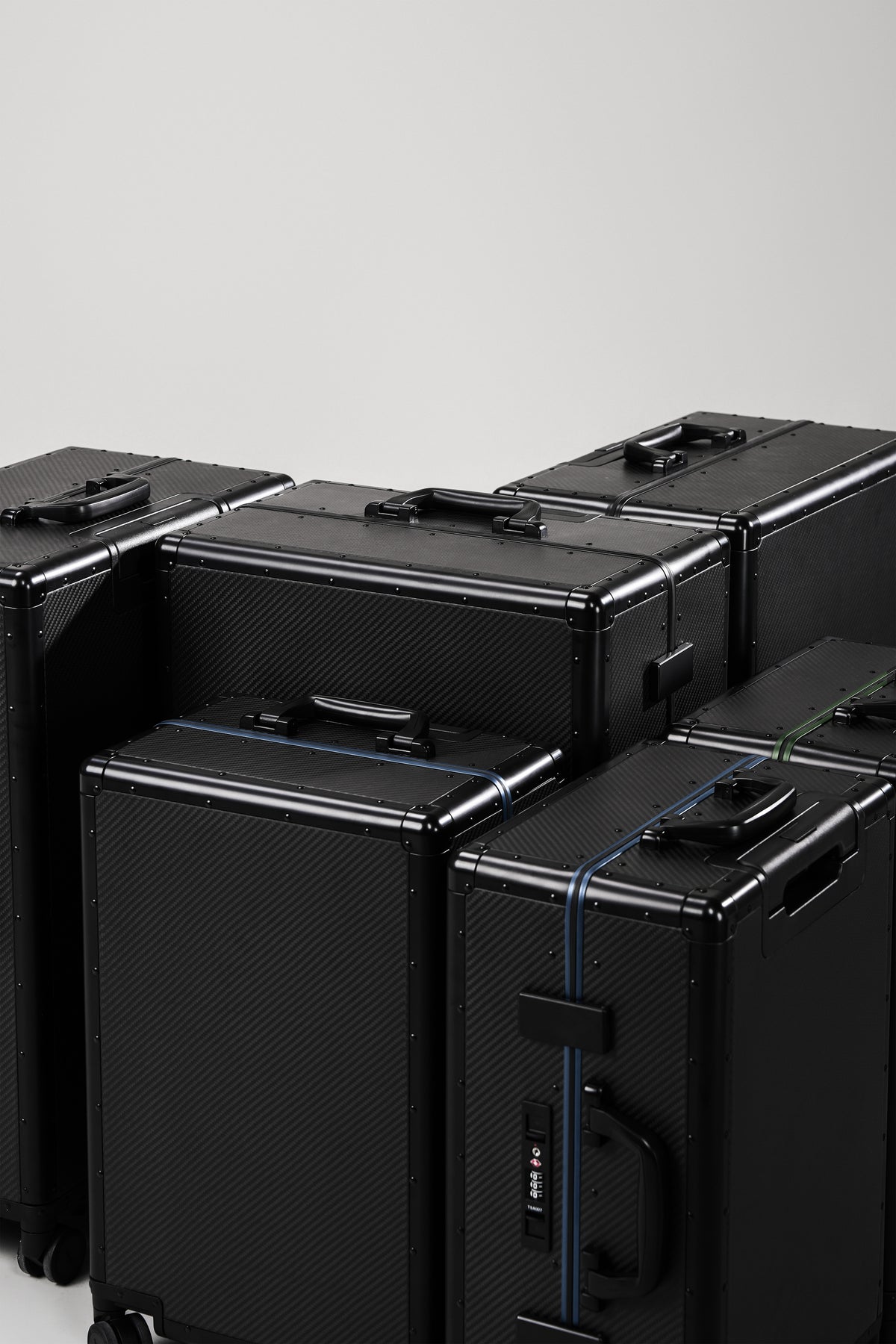
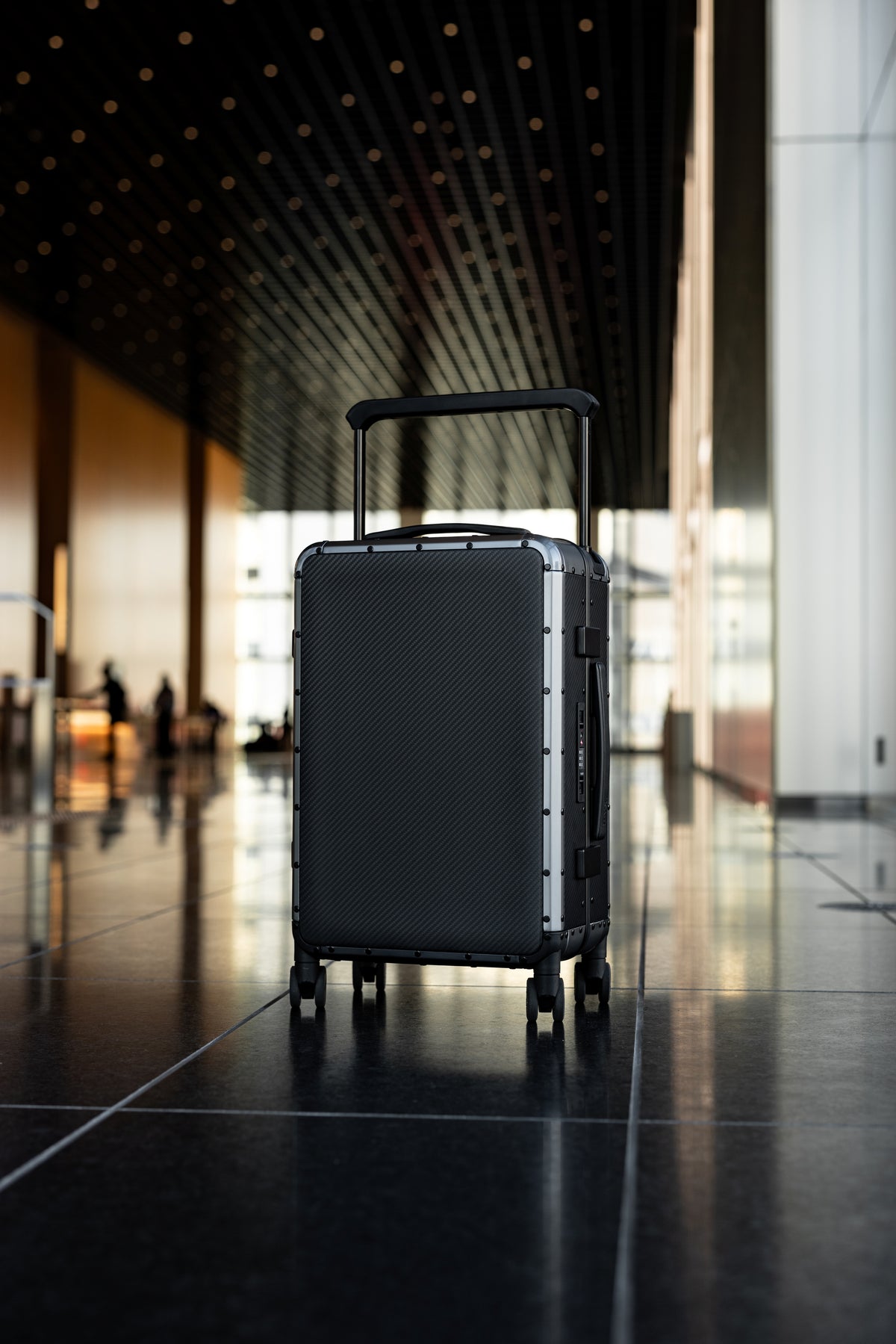

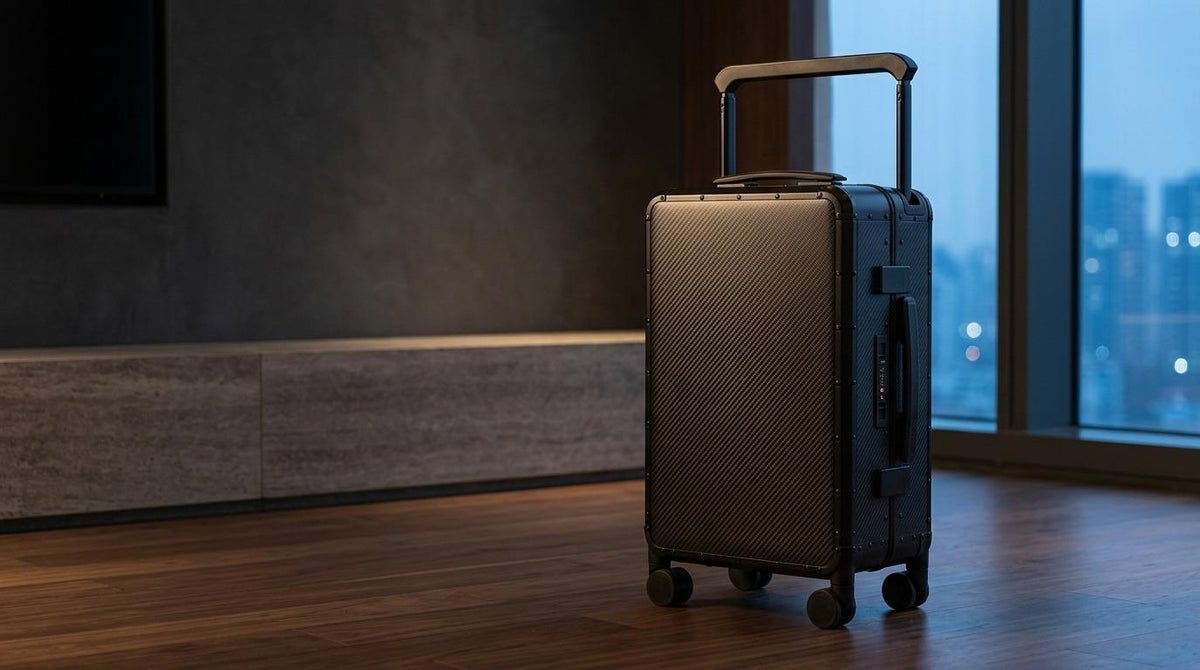

Many high-end carbon fiber suitcases are made with an aluminum frame with a carbon fiber shell, and it's just because carbon fiber excels at its job in the shell, while aluminum excels at its job in the frame. The carbon shell is the body of the case and provides the case with the stiff and structured feel and the unique woven appearance. The aluminum frame around the opening ensures that the edges of the opening close exactly as they should, and provides a secure location for the locks and latches.
MVST's Carbon S 2.0, part of the MVST carbon fiber luggage collection, is one example: the brand states a carbon fiber shell and a 6-series anodized aluminum frame.
Carbon Fiber Shell + Aluminum Frame at a Glance

Think of the case in two parts. The shell is everything you see on the front and back. The frame is the metal band around the middle, where the two halves meet.
| Part | Its job | Why this material | What you notice |
|---|---|---|---|
| Carbon fiber shell | Forms the body of the case | Very stiff for its weight, and can be layered and shaped into curved panels | A rigid, well-braced feel and a visible weave |
| Aluminum frame | Runs around the opening | Holds a precise, consistent edge and gives locks and latches a solid mount | A clean metal line and a closure that lines up neatly |
What Does “Hybrid Construction” Mean in Carbon Fiber Luggage?

Hybrid construction just means a suitcase uses different materials for different jobs, on purpose. In carbon fiber luggage, that usually means a carbon composite shell set into an aluminum frame. Each component is constructed from the material that is most appropriate for the component's function, rather than relying on the same material to perform multiple functions.
The Carbon Shell
A carbon fibre shell is a composite: a very thin carbon fibre that is strengthened in a resin. According to the Federal Aviation Administration, composites are materials with properties that are very unlike each other, which, when joined, will perform properties that neither material could perform alone. The fibers are responsible for the rigidity of the shell and the resin provides shape to it in a suitcase.
The Aluminum Frame
The frame is a metal band that runs around the opening, right where the two halves of the case meet. It’s the clean metal line you see when the case is closed, and it’s where the locks and latches are built in.
Hybrid vs Carbon-Look
A visible weave does not prove a structural carbon fiber shell, because carbon-look finishes exist. The word "hybrid" is also used for cases with no carbon at all: the Monos Hybrid Carry-On pairs a polycarbonate shell with an aluminum frame. That is hybrid construction, but it is not carbon fiber luggage. For the two most common shell materials compared, see aluminum vs polycarbonate luggage.
Why Carbon Fiber Is Used for the Shell
Stiffness for Its Weight
Carbon fiber composites are extremely stiff and strong for their weight. According to the US Department of Energy, carbon fiber reinforced polymer composites can reduce the weight of vehicle parts by more than 60 per cent. In a suitcase, that stiffness provides the shell with a well braced, firm body that maintains shape.
A Look You Can’t Fake
Woven carbon gives the shell a technical surface that looks nothing like molded plastic or pressed metal. The weave isn’t printed on. It’s the material itself, showing through the finish, and it catches the light differently depending on the angle.
Shaped and Layered by Design
A carbon shell is constructed in layers and the direction of the fibres in each layer can be selected. That allows makers to create smooth, curvy panels, and add stiffness precisely where it is required in a suitcase's body.
Crafted, Not Mass-Molded
Carbon shells take more time and care to make than molded plastic ones. A 2020 Covestro case study describes carbon fiber luggage as typically hand-crafted, which is part of why it remains a premium and fairly uncommon choice.
Why Aluminum Is Used for the Frame

The frame looks after the opening: where the case closes, locks and gets opened again at the hotel. Aluminum suits that job very well.
A Precise Closing Edge
Aluminium can be extruded into frame profiles which have a clean and consistent edge. On a zipperless case, that edge takes the place of a zipper, so the two halves meet cleanly and the latches line up.
A Solid Home for Locks and Latches
The locks, latches and hinges are mounted into the metal frame. Opening and closing the case, trip after trip, is handled by a part that’s built for exactly that.
Finish and Look
Many people like the look of a bright metal line around a dark carbon shell. The anodized aluminum frame is used in Carbon S 2.0. The anodizing process creates a hard and protective coating on aluminum.
Why Hybrid Construction Puts Each Material Where It Does
It's easy to see the logic when you examine what each component of the case needs to do.
- The body needs to be stiff and hold its shape. The large front and back of the case are made of carbon composite, which is very stiff for its weight, and can be formed into curved panels.
- The opening needs to be accurate and precise. Aluminum has an exact edge--it is used to make the band that joins and seals the two halves.
- The hardware must be sturdy and have a solid base. Locks and latches are installed in the metal frame designed for daily use.
- The look ties it together. A carbon weave framed by a metal line gives the case an appearance no single-material suitcase has.

Put together, each material does the job it’s best at. The result is a case that feels rigid, closes cleanly and looks distinctive.
How Hybrid Compares With Other Carbon and Aluminum Designs
Carbon and aluminum show up in a few different combinations. Here’s how they differ.
- Carbon shell with an aluminum frame: the carbon look and feel, with a zipperless metal closure. MVST Carbon S 2.0 and monCarbone’s BLACKDIAMOND aluminum-frame model are examples.
- Carbon shell with a zipper: the same carbon body, closed with a zipper around the edge instead of a metal frame. monCarbone also offers its BLACKDIAMOND in this version.
- Full aluminum: shell and frame both in metal, for a classic all-metal look. MVST’s TREVA aluminum luggage is an example.
Which one suits you comes down to the look you prefer and whether you want a framed or a zippered closure.
Can Carbon Fiber Luggage Go Through TSA and Airport Screening?
Yes, and it is screened like any other bag. TSA's technology overview explains that computed tomography (CT) X-ray units screen carry-on bags at checkpoints, and that CT-based explosives detection systems screen 100 percent of checked baggage.
These systems don't treat carbon fiber as a problem, and even a hybrid case features an aluminum frame and metal hardware. The walk-through metal detectors are designed to detect people and not bags. TSA officers inspect it by hand if they suspect a closer examination is needed.
A lock recognized by TSA will allow the officers to open the case without cutting the lock. It is an inspection feature, not an anti-theft certification.
Real-World Carbon Fiber Hybrid Construction Examples
These examples show how brands combine carbon composite and metal differently. They are not a ranking; details are as published on 24 September 2026.
| Product | Shell (brand wording) | Frame / closure | Size / capacity | Price / status |
|---|---|---|---|---|
| MVST Carbon S 2.0 Carry-On | Carbon fiber shell | 6-series anodized aluminum frame; zipperless; TSA-approved combination lock | 23 × 13.8 × 8.7 in incl. wheels; 40 L | From $885 |
| monCarbone BLACKDIAMOND, Aluminum Frame | Carbon fiber, aluminum frame | Aluminum frame; Travel Sentry lock | 555 × 365 × 230 mm; 39 L | $1,650 |
| monCarbone BLACKDIAMOND, Zipper | Carbon fiber, zipper frame | Zipper closure; Travel Sentry lock | 555 × 365 × 230 mm; 41 L | $1,550 |
| Simply Carbon Fiber Classic Carry-On | Matte carbon fiber and aluminum | Trunk-style 50/50 lid; two integrated TSA locks | 21.5 × 13.8 × 9.4 in; capacity not stated | $634.99 sale ($849.99 regular); stock varies |
| TUPLUS Core (Covestro case study) | Carbon-fiber-reinforced polycarbonate shell panels | Aluminum-magnesium alloy structural frame | 25-inch model | China only at launch in 2020; not a current US product |
What to Look For in a Carbon Fiber Hybrid Suitcase
- Genuine carbon fiber composite in the shell, rather than a carbon-look finish.
- The frame material and the type of closure: zipperless latches or a zipper.
- Exterior dimensions, including wheels and handles, that suit the airlines you fly most.
- The finish, interior and features that are consistent with your travel style.
- Clear, published specifications from the brand.
Explore MVST Carbon Fiber Luggage

If a carbon shell on an aluminum frame fits the way you travel, explore MVST carbon fiber suitcases. Both Carbon S 2.0 and Carbon X 2.0 are black and gunmetal, featuring a carbon fiber shell and 6-series anodized aluminum frame. With Carbon X 2.0, the corners are more square for a more architectural look.
Conclusion
Hybrid construction is used in premium carbon fiber luggage as it allows each material to perform its best. The carbon shell provides a firm, solid structure to the case and obvious weave. The aluminum frame ensures a snug closure with a locking edge and stable attachment of the locks and latches. If this duo is your preference, check out the MVST carbon fiber luggage.
FAQs
Is carbon fiber good for luggage?
Yes. A carbon shell is extremely stiff and has a solid shape, and the woven surface provides a look that no other material used in luggage could give. For the hybrid case, the carbon shell is combined with the aluminum frame for closure.
Is carbon fiber basically plastic?
Not exactly. Reinforcement is of carbon fiber. Most shells marketed as carbon fiber are actually composed of a carbon fiber reinforced polymer (CFRP) usually consisting of a polymer resin with the carbon fiber. Resin is plastic, end material is composite which has very different properties from unreinforced plastic.
Why pair a carbon fiber shell with an aluminum frame?
Each material is appropriate for a specific task. The carbon shell provides a rigid, structured body and unique weave, and the aluminum frame provides a clean closing edge and strong platform for the locks and latches.
What does the aluminum frame do on a carbon fiber suitcase?
It runs around the opening, where the two halves of the case meet. It gives the carbon shell a clean metal outline, holds the locks and latches, and gives the case a neat, consistent closing edge.
Why is carbon fiber luggage more expensive?
Carbon fiber is expensive to produce because it is more difficult to create than standard materials used in making luggage, and the carbon shells are layered and applied with great care, often by hand. This is part of the artisanal nature of which you're paying for.
Is carbon fiber considered a luxury luggage material?
It’s generally positioned as a premium material. The raw carbon fiber is costly, the shells take skilled work to produce, and the finished look is distinctive. Those qualities place carbon fiber luggage at the top end of most brands’ ranges.
What should you look for in a carbon fiber suitcase?
You should find a real carbon fiber composite shell, a preferred frame and closure, a size that is appropriate for your airlines and clear specifications from the brand. Also take a look at the finish and interior because that will affect the way the case will feel.
Carbon fiber vs aluminum: what’s the difference for luggage?
Carbon fiber is a composite with a woven look and very high stiffness for its weight. Aluminum is a metal with a bright, classic finish. Hybrid cases use both: carbon for the shell and aluminum for the frame.
How can you tell real carbon fiber from a carbon-look finish?
Check the product description for a clear statement that the shell is carbon fiber composite, not “carbon style” or “carbon effect.” A visible weave alone isn’t proof, so trust brands that state the shell material plainly.
Can carbon fiber luggage go through airport security?
Yes. It’s screened the same way as any other suitcase, using X-ray and CT equipment at the checkpoint and for checked bags.
Sources
Sources and references
- [1]Federal Aviation Administration, Technical Discipline: Advanced Composite Materials, Federal Aviation Administration. Defines advanced composites as materials engineered from constituents with very different properties, combined to perform in ways neither could alone. Accessed 24 September 2026.
- [2]US Department of Energy, Vehicle Technologies Office, Long-Term Lightweight Materials Research (Magnesium and Carbon Fiber), US Department of Energy. Carbon fiber reinforced polymer composites can reduce component weight by more than 60 percent. Vehicle context. Accessed 24 September 2026.
- [3]Transportation Security Administration, Technology fact sheet, Transportation Security Administration. Computed tomography screening for carry-on bags, and CT-based explosives detection systems screening checked baggage. Accessed 24 September 2026.
- [4]Transportation Security Administration, Computed Tomography, Transportation Security Administration. CT produces a 3-D image of a bag’s contents, and officers inspect bags that need further screening. Accessed 24 September 2026.
- [5]Covestro, Carbon fiber composites give luggage a leg up, 2020, Covestro. Supplier case study on carbon-fiber-reinforced luggage shells on an aluminum-magnesium frame, describing carbon fiber luggage as typically hand-crafted. Accessed 24 September 2026.
Stay in the know
Sizing updates, packing systems, and the deals we think are worth it. No more than twice a month.
By clicking submit, you agree to our Privacy Policy.