


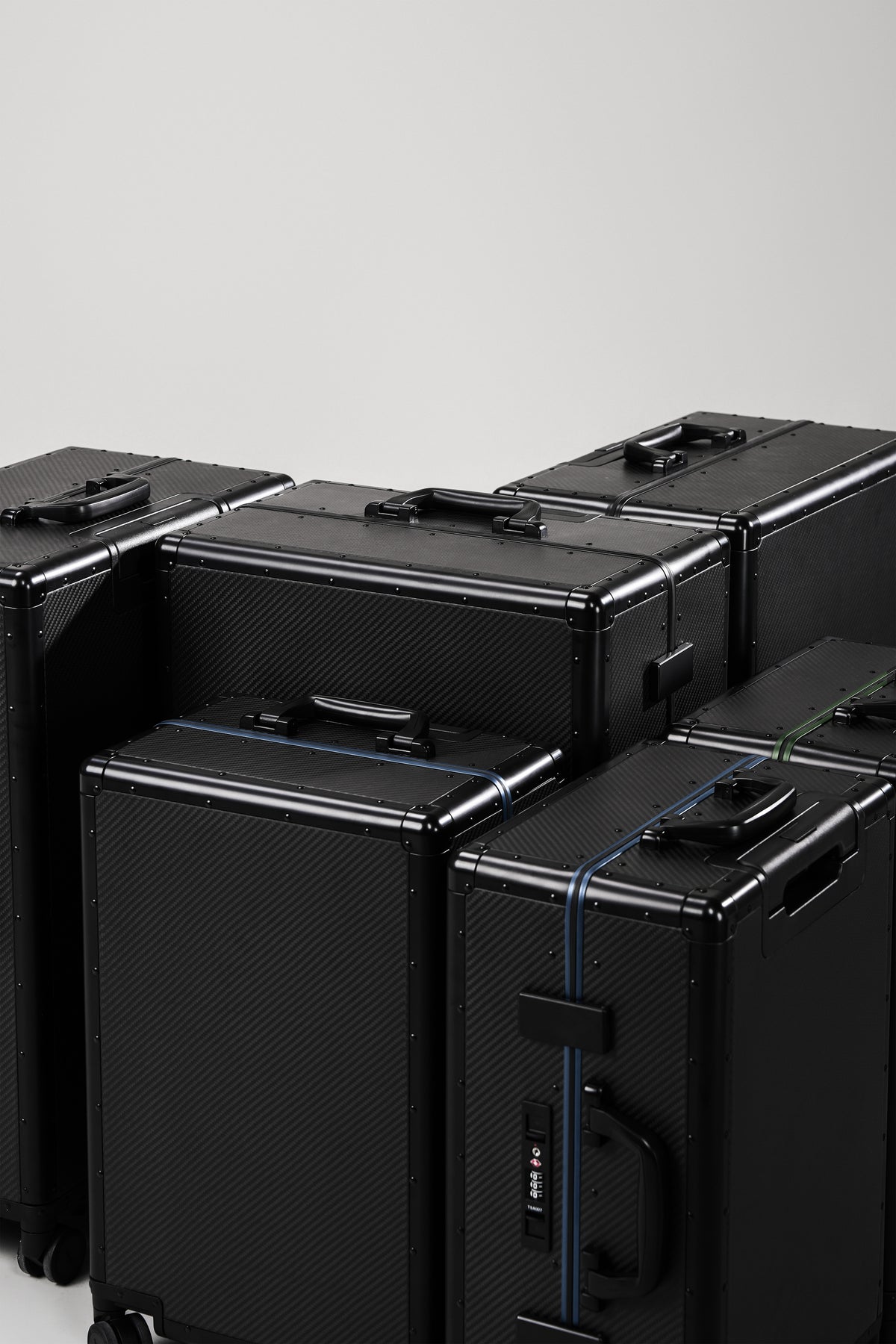
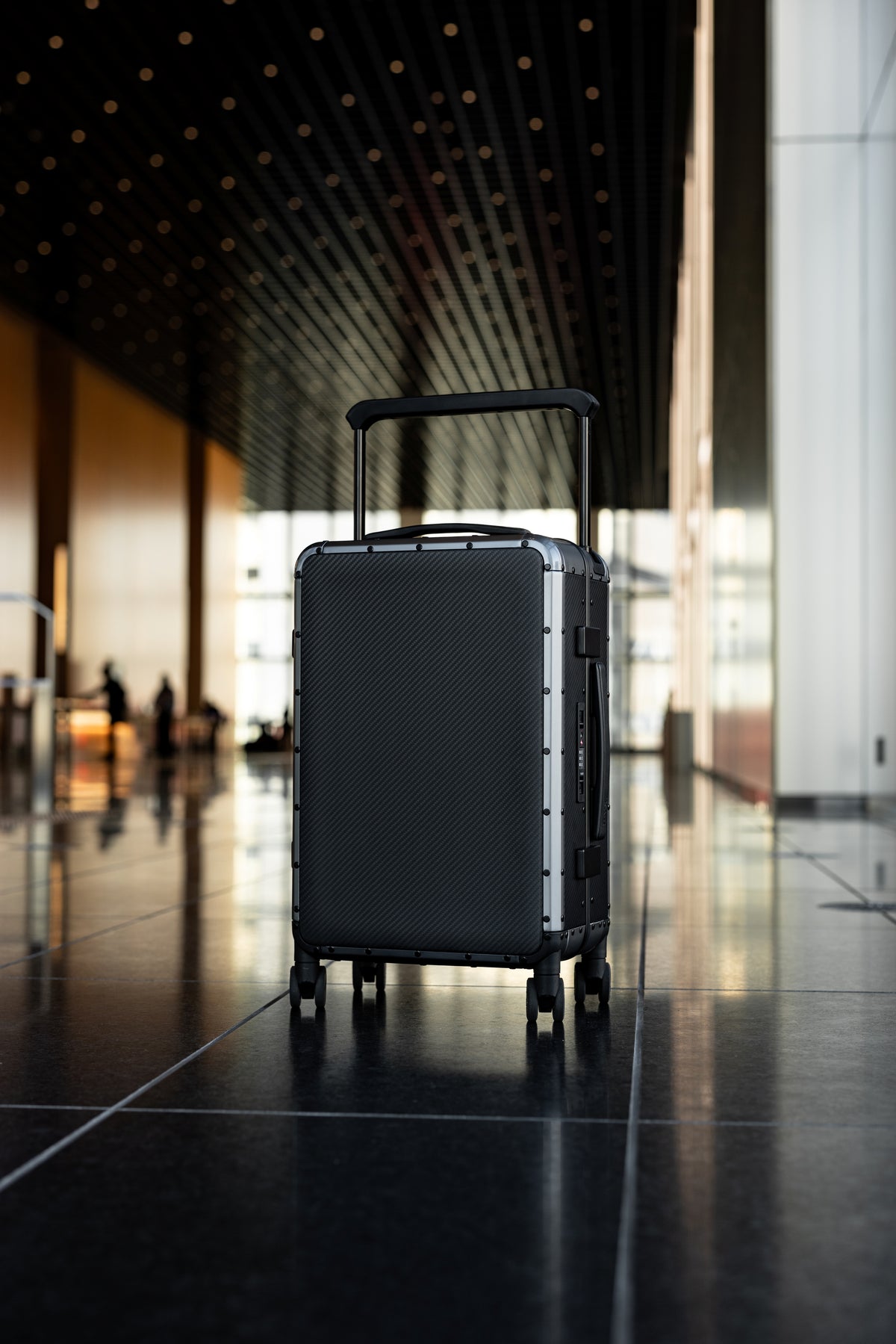


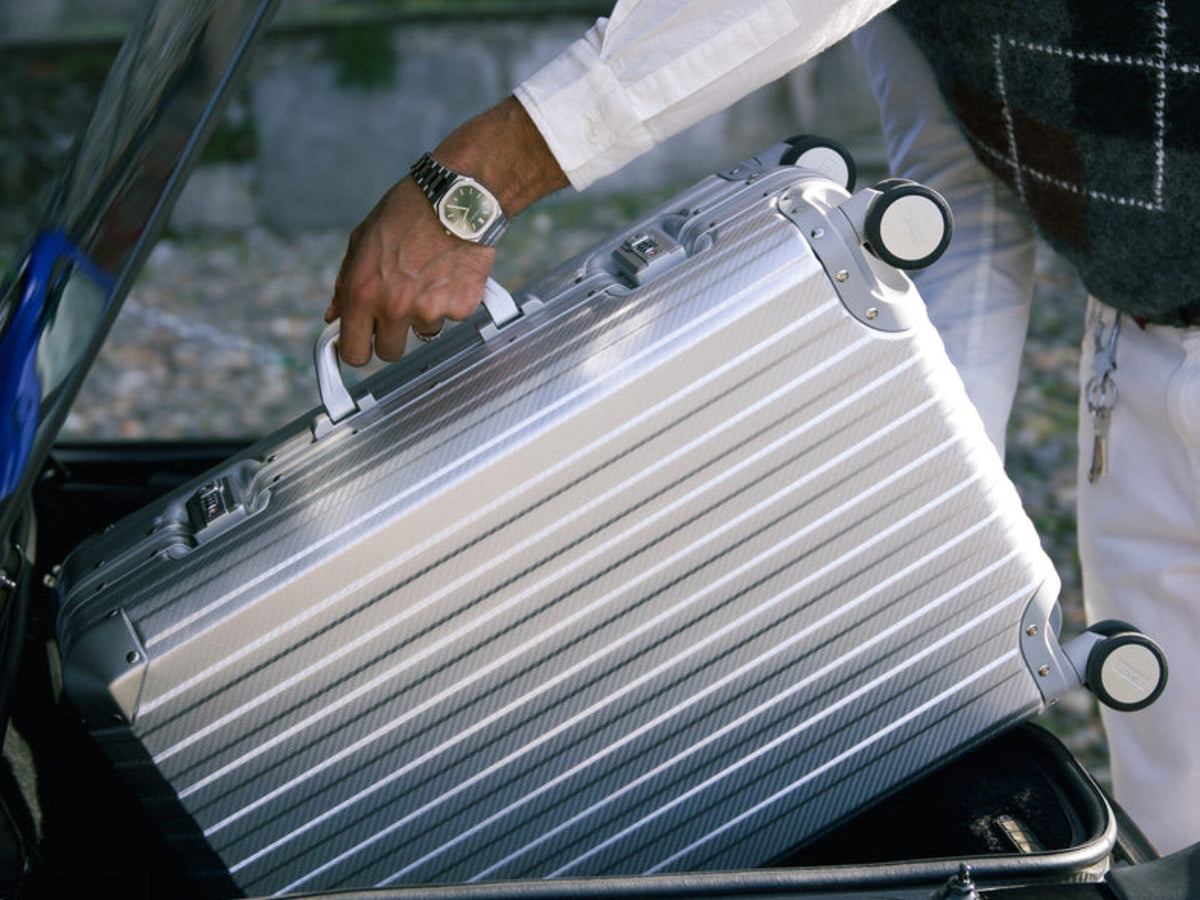

Neither material wins for everyone. Aluminum gives you a rigid metal shell and, on many models, a frame that closes without a zipper. It weighs more and it keeps every dent it collects. Polycarbonate flexes when something hits it, weighs less on most models and usually costs less. Pick based on what you actually need: a low empty weight, or a hard metal case you do not mind scuffing. Then check the finished suitcase, because the material name on its own tells you very little.
If the metal option sounds right, you can see the current TREVA aluminum line-up and pricing.
Aluminum and Polycarbonate Side by Side
Here is the short version. Read the weight and price cells as ranges from real suitcases, not as fixed facts about the material. The full list of models is further down.
| What you are comparing | Aluminum | Polycarbonate |
|---|---|---|
| What happens on impact | Dents. The shell keeps its new shape | Flexes and springs back, or cracks if the hit is hard enough |
| Weight in our sample | 9.37 to 9.5 lb (2 models) | 6.6 to 9.5 lb (3 models) |
| How it ages | Dents, dings and scratches show and stay | Scuffs and scratches. Cracks are possible but not routine |
| Closure on our models | Frame with latches, no zipper | Zipper |
| If it gets damaged | A dent is usually cosmetic. Frame or lock damage is not | A cracked shell usually means replacing the case |
| Price in our sample | $399 to $1,550 | $275 to $525 |
| Buy it when | You want a rigid metal case and do not mind the marks | You are watching a cabin weight limit or a budget |
What to Compare Before You Compare Materials
Start with the whole suitcase. A metal or a plastic has a published strength figure. A suitcase has a frame, a pull handle, wheels, a lining and a shell of some thickness the listing rarely mentions. Those parts add most of the weight, and they are usually the first things to break.
Next, be specific about what you are afraid of. Denting, cracking, scratching and a wheel falling off are four different problems. A dented case still closes and locks. A case cracked at the corner often does not.
Then treat the shell and the closure as one thing. Frames, zippers, locks and corner guards decide what happens when a bag lands on its corner. None of that comes from the shell material.
Compare cases of the same size, and check whether the listed dimensions include the wheels and handles. Plenty of listings leave them out.
Finally, do not assume a higher price means a tougher bag. Consumer Reports tests hard-shell carry-ons in a lab, and Misha Kollontai, the engineer who runs those tests, has said that across more than 20 of them, how well a case performs does not track what it costs.
What You Get With Aluminum

A rigid metal case that holds its shape and shows its history.
Aluminum dents. That is what metal does when something hits it hard, and on its own a dent is cosmetic. What matters is whether the frame still sits properly, the lock still catches and the lid still closes flush. Ask a brand where it draws that line before you buy.
The alloy name matters less than the marketing suggests. The Aluminum Association has run the naming system for aluminum alloys since 1954, and the 5000-series alloys are grouped by how much magnesium they contain. 5083, the one MVST lists for TREVA, is best known in boatbuilding. Useful to know, but it tells you nothing about how thick the shell is, and thickness is what decides how the case handles a knock.
Weight comes from the whole build, not the metal. The MVST TREVA Carry-On is 9.37 lb (4.25 kg) empty at 21.7 × 14.8 × 8.7 in including wheels, checked August 31, 2026. That is 0.13 lb lighter than a RIMOWA aluminum case, and exactly the same as one of the polycarbonate cases below. If you fly most weeks and want luggage built for frequent flyers, weigh the empty case rather than guessing. The per-size weights and dimensions are on the product page, not the collection grid.
What You Get With Polycarbonate
Polycarbonate is the most common hard-shell material because it bends under impact and springs back. SABIC, one of the biggest makers of the raw plastic, describes its grades as having high impact strength. That is measured on test samples in a lab, though. It says nothing about how well a particular factory moulded a particular suitcase.
So does polycarbonate luggage crack easily? No, but no shell is unbreakable either. How likely a crack is depends on the grade of plastic, how thick the shell is, how well it was made, the shape of the panel, the temperature and how much the case has already been through.
One detail is worth knowing, because it changes how you treat your suitcase. Researchers testing polycarbonate impact strength found that the same plastic was five to eight times tougher depending on nothing more than how sharp a notch was cut into the test piece. Sharp notch, it snapped. Rounded notch, it stretched and tore instead.
In plain terms: a deep scratch or gouge from an earlier trip is often what turns a survivable knock into a crack. Cold weather makes it a little more likely too. Treat visible shell damage as a reason to look closely, not something to ignore.
The case for polycarbonate is weight, price and choice. The lightest model below is 6.6 lb at $275. The heaviest polycarbonate model is 9.5 lb. Same material, nearly three pounds apart.
Five Real Carry-Ons Show Why the Label Misleads
Two aluminum cases and three polycarbonate ones, from five brands. Examples, not a ranking. The MVST, RIMOWA and Monos figures come from each brand's current US product page. The Away and Carl Friedrik figures come from Forbes Vetted's 2026 tested round-up, which publishes measured weights. All checked August 31, 2026.
| Product | Shell and closure | Size and capacity | Weight | Price | Group |
|---|---|---|---|---|---|
| MVST TREVA Carry-On | Aluminum alloy; frame closure, no zipper; TSA-approved locks | 21.7 × 14.8 × 8.7 in (incl. wheels); 34 L | 9.37 lb | $399 starting | Aluminum |
| RIMOWA Original Cabin | Anodized aluminum; frame closure; TSA-approved locks | 21.7 × 15.8 × 9.1 in; 35 L | 9.5 lb | $1,550 | Aluminum |
| Monos Carry-On | Polycarbonate; zipper; TSA-accepted lock | 22 × 14 × 9 in; 39.9 L | 6.6 lb | $275 | Polycarbonate |
| Away The Bigger Carry-On | Polycarbonate; aluminum pull handle; zipper | 22.7 × 15.4 × 9.6 in; 49 L | 7.9 lb | from $295 | Polycarbonate |
| Carl Friedrik Hybrid Carry-On | Polycarbonate shell; aluminum lock frame | 22.3 × 14.8 × 9.3 in; 40 L | 9.5 lb | from $525 | Polycarbonate |
| Range across the sample | Five models, two shell materials | 34 to 49 L | 6.6 to 9.5 lb | $275 to $1,550 | — |
Look at the weights. The heaviest polycarbonate case here weighs 9.5 lb, exactly the same as the heaviest aluminum case, and it uses an aluminum lock frame. The lightest and heaviest polycarbonate cases are 2.9 lb apart, a bigger gap than the one between the two aluminum cases. And the most expensive case in the group is not the heaviest or the sturdiest.
If the material set the weight, none of that could happen. A different five suitcases would move every number here, so use this to see the pattern rather than to pick a winner.

Telling Ordinary Wear From Real Damage
Most arguments with a brand start here, so it helps to name the four things that can happen to a shell.
A scuff is marks left on the surface by a belt or a bin edge. It often wipes off. A scratch takes off some finish without bending the shell underneath. Neither one affects how the case works.
A dent is metal that has bent and stayed bent. It is cosmetic while the frame sits right, the lock catches and the lid closes flush. Once a dent runs through a corner or twists the frame channel, it is not cosmetic any more.
A crack goes right through a plastic shell and does not heal. On polycarbonate it usually starts where the shell is already damaged, which is why that old scratch matters.
The shell is not the only thing that fails, so check the moving parts separately. Spin each wheel and listen for grinding. Pull the handle all the way out and feel for side-to-side wobble. Work the lock a few times. On an aluminum case, the TREVA Silver frame, lock and wheel specifications list the parts you would be checking.

What to Avoid When Buying Luggage

Buying on the material name. The five cases above show a 2.9 lb spread inside one material, wider than the gap between the two materials.
Claims with nothing behind them. Aerospace-grade, unbreakable and strongest mean nothing without a test or a certificate to point at.
Assuming the pricier bag is the tougher one. The Consumer Reports finding above is the most useful sentence in this article.
Trusting a size chart that leaves out the wheels and handles. The FAA notes that most airlines cap carry-ons at around 45 linear inches and says to confirm with your carrier, since the agency sets no size itself. Measure the case the way the gate agent will see it.
Skipping the warranty exclusions. Airline damage, ordinary wear and manufacturing faults are handled under separate terms, and the exclusions are where the real boundary sits. MVST publishes its current warranty exclusions in full.
So Which One Should You Buy?

Choose aluminum if you want a rigid metal case with a frame closure, and dents that stay do not bother you. Choose polycarbonate if you need the lowest empty weight or the widest choice at mid-market prices, and check the shell and frame on the specific model rather than trusting the word on the label.
Either way, three checks are the same. Weigh the empty case. Measure it with the wheels. Read what the warranty leaves out.
For the aluminum option, browse current TREVA prices and sizes, then open the size you want for its measured dimensions and empty weight.
FAQs
Which material of luggage is best?
There is no best luggage material, only the best fit for your trip pattern and budget.
- Aluminum suits travelers who want a rigid metal shell and a framed closure, and who accept dents and roughly 9.4 lb of empty weight in a carry-on.
- Polycarbonate suits travelers managing a cabin weight limit or a mid-market budget, though its performance varies sharply with shell thickness and molding quality.
- Carbon fiber suits a narrow group who specifically want composite construction and have verified the build.
Across our six-model sample, construction changed weight more than material did. Start by writing down your cabin weight limit, then filter by empty weight before you filter by material.
Which is better for luggage, polycarbonate or aluminum?
- Polycarbonate reaches lower weights and lower prices, while aluminum gives you shell rigidity and, on many models, a framed zipperless closure. In our sample, polycarbonate models ran 6.6 to 9.5 lb at $275 to $525, and aluminum models ran 9.37 to 9.5 lb at $399 to $1,550. Under some impacts polycarbonate may crack while aluminum may deform, but the outcome depends on shell construction and impact conditions rather than on the material label.
- Aluminum also shows every mark it collects, which some owners like and others do not. If you are leaning aluminum, check the empty weight listed for the exact TREVA size you need before comparing it against a polycarbonate model of the same capacity.
What is the most durable material for luggage?
Define the failure mode first, because durability is not one score.
- Against denting, polycarbonate performs better since it flexes and recovers.
- Against permanent deformation of the frame and closure, a well-built aluminum case holds its geometry.
- Against abrasion, the finish matters more than the substrate.
Consumer Reports rates impact resistance and construction quality as separate criteria for exactly this reason, and its testing lead has noted that performance does not correlate with price across the hard-shell carry-ons the organization has tested.
Does polycarbonate luggage crack easily?
Polycarbonate is designed to flex under impact, but cracking risk varies with resin grade, shell thickness, molding quality, geometry, temperature and load history.
Peer-reviewed Charpy testing published in Polymers in 2024 measured the same polycarbonate at roughly 15 kJ/m² of impact toughness with a sharp 0.10 mm notch and 70 to 120 kJ/m² once the notch radius reached 0.25 mm or more. In practice, an existing deep scratch or gouge is what turns a survivable impact into a crack, so treat visible shell damage as a reason to inspect rather than ignore.
Do aluminum suitcases dent when checked by airlines?
Yes, and on a metal shell that is the expected outcome rather than a defect. Aluminum absorbs impact energy by deforming permanently instead of flexing back, so a checked aluminum case will collect dents and edge marks over time. The functional question is whether the frame still seats, the lock still engages and the lid still closes flush. If all three hold, the case is working as designed even though it looks used.
How can you tell if luggage is good quality?
Check the parts that move before you check the shell.
- Inspect wheels, handles, locks and joints separately
- Spin each wheel and listen for grinding
- Extend the handle fully and feel for side-to-side play, and cycle the lock several times
- Look at the corners and joints, since impact loads concentrate there rather than in the middle of a panel.
- Confirm the published empty weight, whether the dimensions include wheels, and what the warranty excludes. A specification sheet that will not tell you the empty weight is telling you something anyway.
Sources
Sources and references
- [1]Misha Kollontai, engineer leading luggage testing, Consumer Reports. Hard-shell carry-on lab testing; finding that performance does not correlate with price. Accessed August 31, 2026.
- [2]Xueting Xu, lead author, notch and molecular weight effects on polycarbonate impact fracture, Beijing Institute of Aeronautical Materials. Polymers, vol. 16, no. 8, 1072, 2024. Charpy impact toughness across notch geometries. Accessed August 31, 2026.
- [3]Tao Wang, corresponding author, same study, Baimtec Material Co., Beijing. Brittle-to-ductile transition data and residual stress measurement. Accessed August 31, 2026.
- [4]Merlin Theodore, PhD, group leader, Advanced Fibers Manufacturing Group, and director of the Carbon Fiber Technology Facility, Oak Ridge National Laboratory. Carbon fiber properties, cost constraints and manufacturing energy intensity. Accessed August 31, 2026.
- [5]John Weritz, vice president for standards and technology, The Aluminum Association. Wrought alloy designation system and 5xxx-series applications. Accessed August 31, 2026.
- [6]Federal Aviation Administration, Carry-On Baggage Tips, Office of Aviation Safety, U.S. Department of Transportation. Carry-on size guidance and the instruction to confirm limits with the operating carrier. Accessed August 31, 2026.
- [7]SABIC, Polycarbonate (PC) resin technical overview, SABIC Polymers. General PC resin properties including impact strength and thermal stability. Accessed August 31, 2026.
- [8]Forbes Vetted, editor-tested luggage round-up, 2026 edition, Forbes. Measured weights, capacities and dimensions for the Away and Carl Friedrik carry-ons. Accessed August 31, 2026.
Stay in the know
Sizing updates, packing systems, and the deals we think are worth it. No more than twice a month.
By clicking submit, you agree to our Privacy Policy.