





When lightest weight and packing space is the key consideration, polycarbonate is generally the more practical solution. When you're looking for a metal shell that's rigid and has a framed, latch-lock construction, then aluminum is the better option if you're looking for a specific model that you've confirmed.
Durability is not the deciding factor: aluminum can bend and buckle, polycarbonate can flex and crack if stretched beyond its capacity. Neither pattern supports calling one material stronger without comparable testing. Security depends on frame, closure and lock design rather than the shell itself.
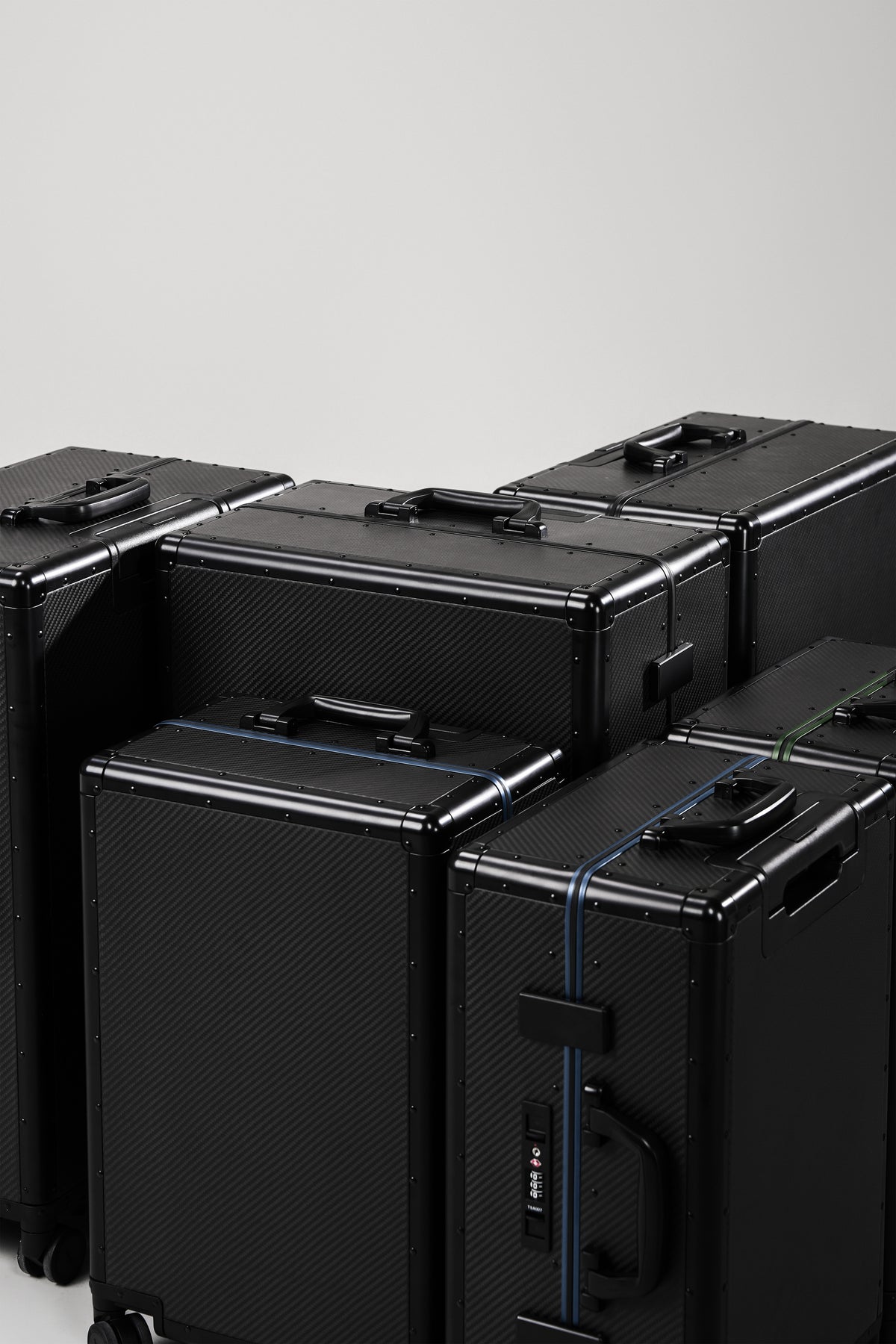
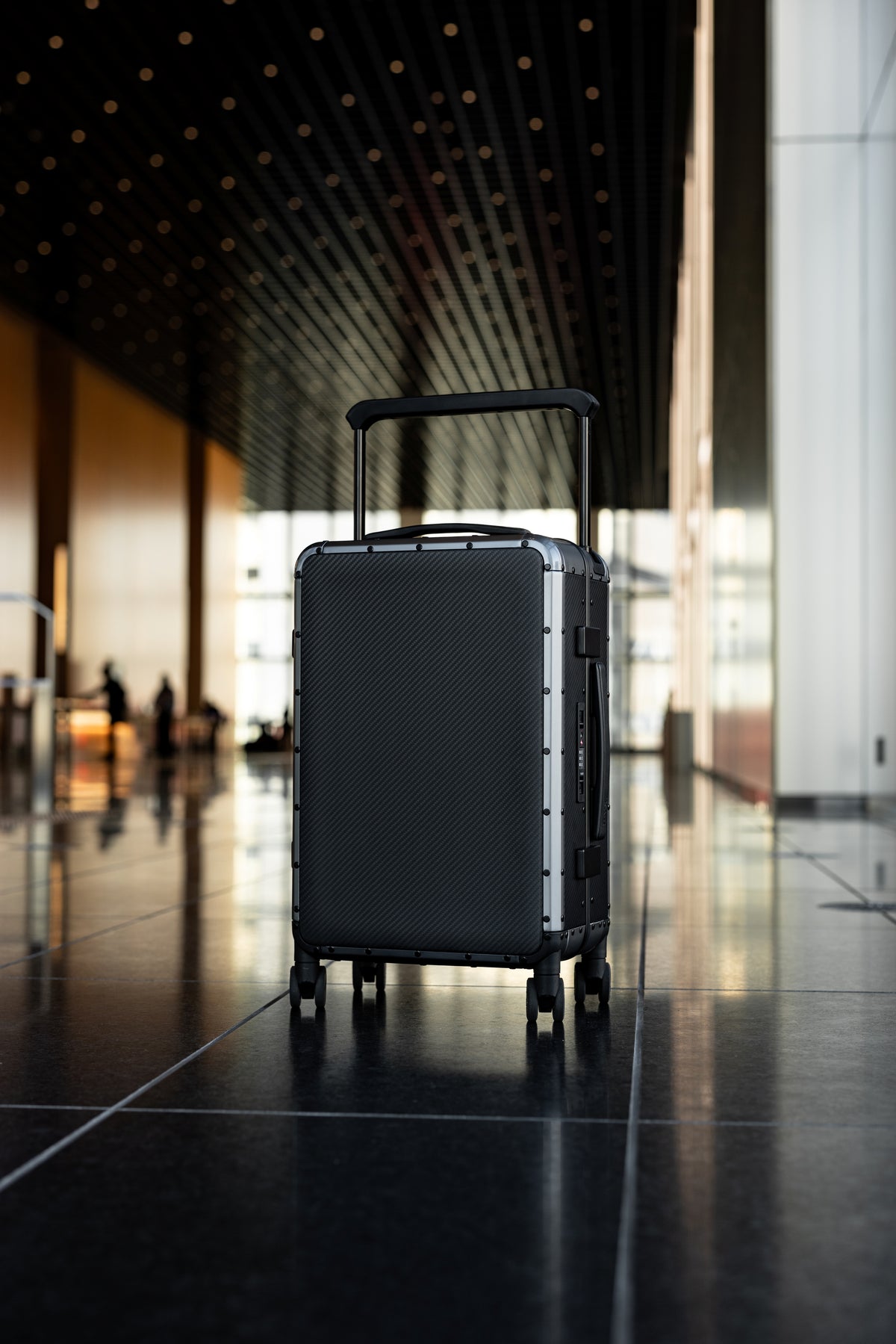
If a rigid metal shell is what you are after, the TREVA aluminum luggage collection is MVST's aluminum line.
Aluminum vs Polycarbonate Luggage at a Glance
The table below applies the same criteria to both materials. Every row describes what current models tend to do, not what the material must do. Aluminum does not automatically mean a zipperless frame, and polycarbonate does not automatically mean a zipper. Those are construction choices a brand makes, and you can find both closures on both materials.
The Alloy family sits behind most aluminum marketing. The Aluminum Association has run the wrought alloy designation system since 1954, and 5xxx-series alloys are grouped by magnesium content, with 5083 best known in marine work. That tells you nothing about shell gauge, which is where impact behavior is decided.
| Comparison factor | Aluminum luggage | Polycarbonate luggage |
|---|---|---|
| Finished carry-on weight | Heavier in both controlled pairs below; verify the model | Lighter in both controlled pairs below; verify the model |
| Impact behavior | Rigid metal can dent or deform under force | Thermoplastic shell can flex; may crack if its limits are exceeded |
| Visible wear | Dents, dings, scuffs and scratches can be conspicuous | Scuffs and scratches common; cracking is conditional, not routine |
| Rigidity and packing give | Low shell give on rigid framed models | More shell flex on many models; closure design still governs |
| Closure examples | Many premium examples use zipperless frames and latches. Not inherent to aluminum | Many examples use zippers. Not inherent to polycarbonate |
| TSA lock | Present on the verified aluminum examples below | Present on the verified polycarbonate examples below |
| Security conclusion | Depends on frame, latch or zipper, and lock design | Depends on frame, latch or zipper, and lock design |
| Price | Higher within each same-brand pair below | Lower within each same-brand pair below, though not across brands |
| Best fit | You want rigid metal-shell, framed construction | You want lower empty weight and some shell flex |
Which Is Lighter, Aluminum or Polycarbonate Luggage?

Compare Finished Suitcases, Not Raw Materials
Shell, frame, latches, handles, wheels, lining and exterior dimensions all feed into what a case weighs empty. Raw density gets you nowhere useful. A generic figure such as “aluminum adds two pounds” only means something if it came from a named product pair at the same size.
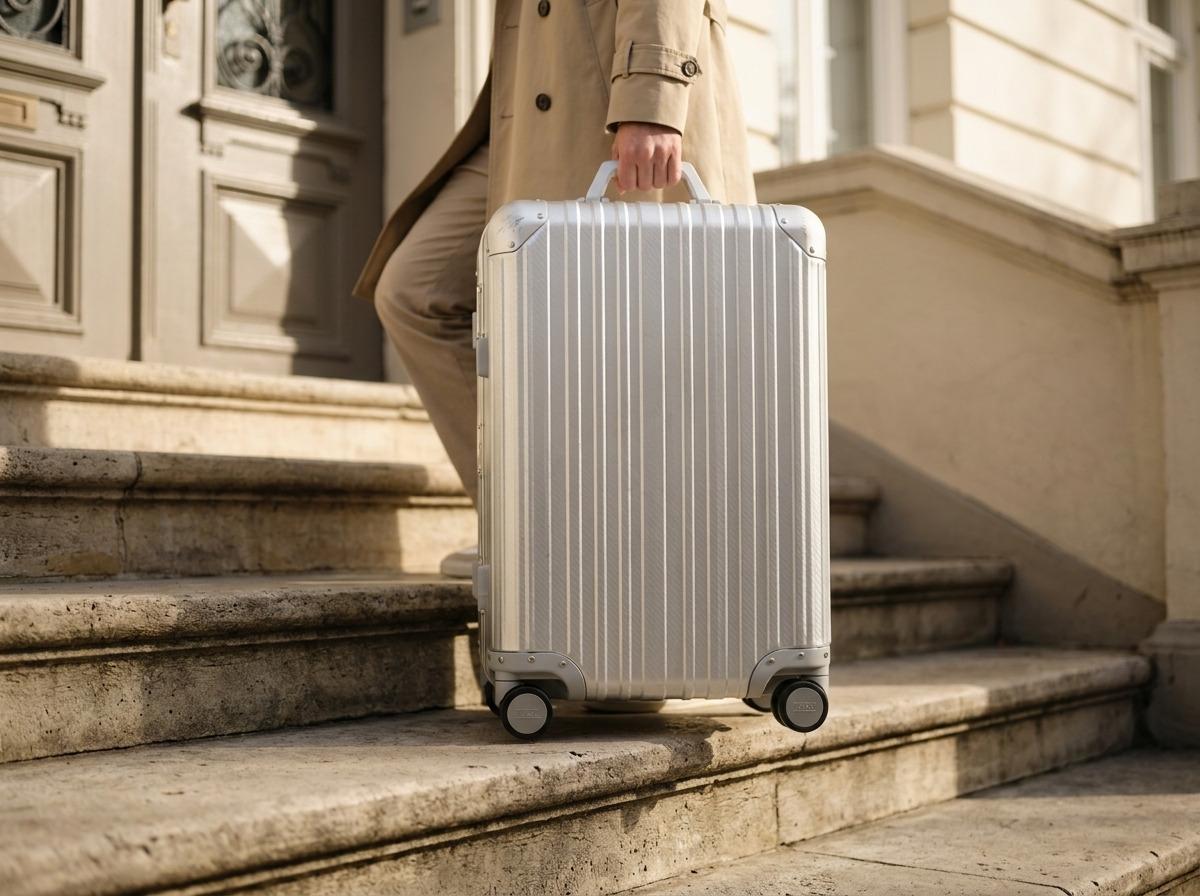
The RIMOWA Original and Essential Weight Example
RIMOWA publishes two cabin cases at identical exterior dimensions, 21.7 × 15.8 × 9.1 in with wheels and handles included. The aluminum Original Cabin is 9.5 lb at 35 L. The polycarbonate Essential Cabin is 7.1 lb at 36 L. The gap is 2.4 lb, and the polycarbonate case holds a litre more.
The Monos pair points the same way and lands somewhere else. Its aluminum Carry-On is 11 lb; its polycarbonate Carry-On is 6.60 lb. That gap is 4.4 lb, nearly double RIMOWA's. Both pairs agree on direction. Neither gives you a fixed number to carry to another brand. MVST's own aluminum case sits below both aluminum examples, and the TREVA Carry-On specifications list 9.37 lb at 34 L.

Why Empty Weight Matters for Airline Limits
If a carrier has a cabin or checked bag weight limit, the empty case is deducted from the weight limit first. A cabin suitcase is limited to 10 kg, and a 4.25 kg suitcase leaves 5.75 kg for your belongings. Check the airline you're really travelling on instead of assuming a standard as their caps vary and are subject to change.

Which Is More Durable, Aluminum or Polycarbonate?
Dents, Deformation and Surface Wear on Aluminum
Aluminum absorbs dents, dings, scuffs and scratches. That is not necessarily a concern if it is not severe and not in an area that is important. A shallow dent that is in the middle of a panel is cosmetic. A dent that runs through a corner or distorts the frame channel can stop the case closing flush, and that is a functional problem.
Warranty language marks the boundary better than marketing does. MVST's limited lifetime warranty terms separate cosmetic scratches, dents, dings and scuffs from manufacturing defects, and treat shell cracks and breaks as a different category. MVST product care guidance covers the cleaning and handling side. Read both before you assume a mark is covered.
Flexing, Rebound and Cracking in Polycarbonate
Polycarbonates are flexible and recover to their original shape when impacted. SABIC, one of the biggest producers of PC resin, states that the grades have high impact strength and thermal stability. These are resin characteristics taken from test bars – which cannot necessarily be transferred to a moulded shell.
Does polycarbonate luggage crack easily? No, but no shell is unbreakable either. A 2024 study in the peer-reviewed journal Polymers ran Charpy impact tests on two polycarbonate grades across a range of notch geometries. The same material measured roughly 15 kJ/m² of impact toughness at a sharp 0.10 mm notch and 70 to 120 kJ/m² once the notch radius reached 0.25 mm or more.
A five to eightfold swing, from geometry alone. It was also found that higher-molecular-weight polycarbonates fractured in a more ductile fashion than lower molecular weight polycarbonates at a sharper notch and that residual stress from injection molding was correlated with the result. Resin grade, shell thickness, moulding quality, geometry, temperature and load history are the variables. An existing deep scratch is often what turns a survivable impact into a crack.
What More Durable Should Mean Here
Durability is not one score. Cosmetic appearance, shell integrity, closure integrity, wheel and handle life, and repairability are five separate questions, and the two materials do not rank the same way on all five. Without comparable drop, compression and abrasion testing across matched models, this article does not name a durability winner. Anyone who does without that data is guessing.

Which Is More Secure, Aluminum or Polycarbonate Luggage?

Zipperless Frames vs Zipper Closures
Security is a construction question, not a material one. The verified examples make that plain. Both TREVA and Monos Aluminum Carry-On are equipped with zipperless frames with TSA-compatible latch locks. Monos polycarbonate Carry-On has YKK reverse-coil zippers with TSA-approved combination lock. TSA approved locks are listed on both RIMOWA's Original and Essential.
So lock presence does not separate the materials, and neither does closure type, since both closures appear on both materials across these five models. A zipperless frame is not tamper-proof and a zipper is not inherently insecure. Without controlled security testing, that is as far as the evidence goes.
What TSA-Recognized Locks Actually Mean
There are also TSA recognized locks, so that the officers can open a bag for inspection with a universal master key, without having to cut the lock. The TSA is clear that locks can be cut when they cannot be opened otherwise and that the TSA is not responsible for bags being damaged due to the opening of the bag for security reasons.
This is inspection access, not a burglary-resistance rating. In its advice on bags and suitcases, The US Department of Transportation states it isn't a good idea to use suitcase locks because they can be broken, and it encourages travelers to carry items rather than leave them in their bags. No shell material changes that.
What the Price Difference Actually Buys
Same-Brand Price Examples
RIMOWA's Original Cabin is $1,550 against $990 for the Essential Cabin, a $560 gap at identical exterior dimensions. Monos lists its Aluminum Carry-On at $695 against $275 for the polycarbonate Carry-On, a $420 gap. TREVA Carry-On is $399. All US prices verified 3 September 2026.
Now compare across brands and the pattern breaks. RIMOWA's polycarbonate Essential at $990 costs more than Monos' aluminum Carry-On at $695. Polycarbonate is cheaper within a brand. It is not cheaper than aluminum in general, which is how most comparisons phrase it.

Price Is Also Brand, Hardware, Construction and Service
Shell manufacturing, frame and latch design, wheels, handles, interior, warranty terms, service network and brand positioning all move retail price. Consumer Reports, whose engineer Misha Kollontai leads its luggage testing, has found that across more than 20 hard-shell carry-ons tested, performance does not correlate with price. Aluminum cannot be called cheaper over a lifetime without comparable lifespan, repair-frequency and warranty evidence, and that evidence does not exist here.
Five Real Carry-Ons Compared Side by Side
Three aluminum cases, two polycarbonate, across three brands. These are examples rather than rankings, and no review scores are included. US pricing and specifications verified 3 September 2026; recheck on publication day.
Note how each brand states its dimensions. TREVA's page says measurements include wheels but does not explicitly mention handles. RIMOWA states wheels and handles. Monos states wheels and fixed handles. Comparing exterior numbers across brands is therefore approximate, not exact.
| Product | Material | Exterior and capacity | Weight | Closure and lock | US price |
|---|---|---|---|---|---|
| MVST TREVA Carry-On | Aluminum alloy | 21.7 × 14.8 × 8.7 in; 34 L; page says dims include wheels | 9.37 lb | Zipperless frame; TSA-approved locks | $399 |
| RIMOWA Original Cabin | Anodized aluminum | 21.7 × 15.8 × 9.1 in; 35 L; wheels and handles included | 9.5 lb | TSA-approved locks; rigid aluminum case | $1,550 |
| RIMOWA Essential Cabin | Polycarbonate | 21.7 × 15.8 × 9.1 in; 36 L; wheels and handles included | 7.1 lb | TSA-approved locks | $990 |
| Monos Aluminum Carry-On | Aluminum alloy | 22.2 × 14.2 × 9.3 in; 34 L; wheels and fixed handles included | 11 lb | Zipperless frame; two TSA-accepted combination locks | $695 |
| Monos Carry-On | Polycarbonate | 22 × 14 × 9 in; 39.9 L; wheels and fixed handles included | 6.60 lb | YKK reverse-coil zippers; TSA-accepted combination lock | $275 |
Which Should You Choose, Aluminum or Polycarbonate?

When the need is for low weight, opt for Polycarbonate
The lighter shell comes out on top above if you fly a carrier with cabin weight limits or you would prefer to have a lighter case that's easier to lift into an overhead bin. Some shell flex also helps when a bag is packed full. Verify the empty weight of the specific size rather than trusting the material label.

Choose Aluminum When Rigid Framed Construction Is the Priority
Aluminum is the right call when you want the verified construction of an actual model: metal shell, rigid frame, latch locks, reinforced corners, and you accept higher empty weight and visible cosmetic wear. TREVA is MVST's aluminum line, and the case for it is its published specifications, not a claim of superior protection.
Carry-On and Checked Use Do Not Follow a Universal Rule
Some travelers pick the lighter case for strict weight limits and some pick the rigid one for their own packing habits. There is no airline or crew consensus that one shell material belongs in the cabin and the other in the hold. The FAA advises checking your airline's own carry-on guidelines, since carriers set their own size and weight rules.
What to Avoid When Buying Either Material
Material labels with no model-level shell, frame, closure, weight and dimension data behind them.
Unsupported terms. Aerospace-grade, unbreakable, most secure, crush-proof and strongest all mean nothing without a standard number, a test method or a certificate.
Comparisons between different suitcase sizes presented as material differences.
Ignoring empty weight when your carrier enforces a baggage-weight limit.
Treating a TSA-compatible lock as theft-proof certification. It is inspection access.
Warranty claims taken from product-page shorthand or an outdated policy page instead of the current formal policy.

Conclusion
Polycarbonate saved 2.4 lb at RIMOWA and 4.4 lb at Monos in the current examples. Aluminum offers a rigid metal shell and, on several verified models, zipperless framed construction. Durability and security still depend on the complete suitcase rather than the shell material. If the rigid option fits your travel, browse current TREVA prices and sizes and check the empty weight of the size you need.
FAQs
What are the disadvantages of aluminum suitcases?
Higher empty weight and conspicuous cosmetic wear are the two most consistent drawbacks. In the pairs above:
- Aluminum cases ran 2.4 lb heavier at RIMOWA and 4.4 lb heavier at Monos, which comes straight out of any enforced baggage allowance.
- Dents, dings and scratches also show and stay, and they are typically excluded from manufacturing-defect warranty coverage.
- Price runs higher within each same-brand pair too.
None of this makes aluminum impractical, it simply means the trade-off is weight and appearance in exchange for a rigid metal shell.
Does polycarbonate luggage crack easily?
No, but no shell is unbreakable. Polycarbonate is chosen for luggage precisely because it resists impact by flexing. Cracking becomes possible when resin grade, shell thickness, geometry, moulding quality, temperature or load history work against it.
Which is better for luggage, polycarbonate or aluminum?
Polycarbonate is usually the better fit when empty weight matters most, and aluminum when you want a rigid metal shell with framed, latch-lock construction and will accept the weight and the marks. There is no universal winner, and the comparison changes model by model.
Is aluminum stronger than polycarbonate?
Not in a way that answers the luggage question. Strength depends on which property you measure, and a finished suitcase behaves differently from a test coupon. Aluminum resists puncture and holds its shape under load, while deforming permanently when it fails.
Polycarbonate absorbs impact by flexing and recovering, while cracking when its limits are exceeded. Comparing impact response and failure mode on named models is more useful than ranking raw materials.
Are aluminum suitcases heavier than polycarbonate luggage?
In current comparable examples, yes.
- RIMOWA's aluminum Original Cabin is 9.5 lb against 7.1 lb for the polycarbonate Essential Cabin at identical exterior dimensions.
- Monos' aluminum Carry-On is 11 lb against 6.60 lb for its polycarbonate Carry-On.
- Both pairs point the same direction, but the gap is 2.4 lb in one case and 4.4 lb in the other, so treat these as a demonstrated pattern rather than a fixed number.
Is an aluminum suitcase worth it?
That depends on your airline's weight rules, the closure and frame you want, the repair and warranty terms, how you expect to use the case and your budget. Aluminum is worth it if a rigid metal shell and framed construction genuinely matter to you and the extra empty weight does not cost you the allowance you need.
What is the most durable luggage material?
Define durability before answering. Aluminum holds shape and resists puncture but marks permanently. Polycarbonate stays visually cleaner and flexes but cannot be repaired once cracked. Pick the failure you most want to avoid, then compare specific models on that one axis.
What should you avoid when buying luggage?
- Vague material claims with no model-level data
- Unsupported language such as unbreakable or aerospace-grade
- Exterior dimensions that do not state whether wheels and handles are included.
- Avoid ignoring empty weight if your carrier enforces a baggage-weight limit, since the case eats your allowance before you pack.
- Check the hardware in person where you can: spin the wheels, extend the handle and feel for play, and cycle the lock.
- Read the current formal warranty policy rather than the shorthand on a product page.
Do airlines prefer hard or soft luggage?
Airlines publish rules on size, weight and contents rather than a preferred shell type. Neither hard-shell nor soft-sided luggage is favored as a category in carrier baggage policies. The FAA advises confirming carry-on guidelines with the airline you are flying.
What suitcase do flight attendants say not to use?
There is no official airline or FAA prohibition on aluminum or polycarbonate luggage as a material choice, and claims circulating on social media to that effect are not sourced to any carrier policy. What actually governs cabin luggage is dimensions, weight and safe stowage in the overhead bin or under the seat.
Sources
Sources and references
- [1]John Weritz, vice president for standards and technology, The Aluminum Association. Wrought alloy designation system and 5xxx-series background. Alloy family context only; it does not demonstrate suitcase performance. Accessed 3 September 2026.
- [2]SABIC, Polycarbonate (PC) resin technical overview, SABIC Polymers. General PC properties including impact strength and thermal stability. Resin-level properties, not a guarantee that a shell cannot crack. Accessed 3 September 2026.
- [3]Xueting Xu, lead author, notch and molecular weight effects on polycarbonate impact fracture, Beijing Institute of Aeronautical Materials. Polymers, vol. 16, no. 8, 1072, 2024. Charpy impacts toughness across notch geometries. Accessed 3 September 2026.
- [4]Misha Kollontai, engineer leading luggage testing, Consumer Reports. Hard-shell carry-on lab testing; finding that performance does not correlate with price. Accessed 3 September 2026.
- [5]Transportation Security Administration, Travel Tips, baggage and recognized locks, US Department of Homeland Security. Recognized locks allow inspection without cutting where possible; TSA is not liable for damage to locked bags opened for screening. Not an anti-theft rating. Accessed 3 September 2026.
- [6]US Department of Transportation, Plane Talk, Tips on Avoiding Baggage Problems, Office of Aviation Consumer Protection, US Department of Transportation. Advises travelers not to rely on suitcase locks and to carry valuables rather than check them. Accessed 3 September 2026.
- [7]Federal Aviation Administration, Carry-On Baggage Tips, Office of Aviation Safety, US Departments of Transportation. Instruction to confirm carry-on guidelines with the operating airline. Accessed 3 September 2026.
Stay in the know
Sizing updates, packing systems, and the deals we think are worth it. No more than twice a month.
By clicking submit, you agree to our Privacy Policy.