


Checked luggage problems come down to two separate measurements, and a bag has to pass both. Size is measured in linear inches, meaning height plus width plus depth added together, with 62 in or 158 cm the common ceiling. Weight is measured separately, with 50 lb or 23 kg the common economy allowance. Fail either and a fee applies; fail both and some carriers charge for both. Neither limit is universal, so check the airline operating each flight. Verified 16 September 2026.
What Is the Standard Checked Luggage Size
62 Linear Inches Explained
Linear inches is not a length. It is the total of the three outside dimensions (height + width + depth). A 29 by 20 by 12 in case totals 61 linear inches. Delta states that a standard checked bag can be no bigger than 62 in (158 cm) in total. Several other airlines specify 158 cm (62 in) as the maximum dimension for a standard checked bag.
However, 62 in is a standard that is widely accepted, but not universally guaranteed. Route, fare, cabin and carrier can all change it, and some airlines cap individual sides as well as the total.
Why Airlines Measure External Dimensions

Airlines measure the outside of the packed bag, including wheels, fixed handles and anything that protrudes. Interior capacity in litres is a separate figure that tells you how much fits inside. It has no bearing on whether the bag clears the limit.
Size vs Weight: What Airlines Actually Check

Size Limit Rules
The bag is measured as a total. Exceed it and the bag is oversized, regardless of what it weighs. A light but bulky case still attracts an oversize fee, which surprises people packing bedding, sports gear or empty-looking bulk.
Weight Limit Rules
The bag is weighed. It refuses checked bags (not at all on its operated flights) of over 100 lb (45 kg) without charging a fee, a hard refusal that is common in the American states it does not serve.
Which Failure Is More Common
Overweight, by a wide margin, because weight creeps up as you pack while dimensions are fixed the day you buy the case. Size failures cluster on large and extra-large cases, which start close to the line before anything goes in.
US vs International Checked Baggage Rules
- US carriers publish in pounds and inches. Common economy allowance: 50 lb and 62 linear in.
- International carriers usually publish in kilograms and centimetres. Common equivalents: 23 kg and 158 cm.
- 23 kg is 50.7 lb, so the two are near-identical in practice. The units differ more than the rules do.
- Piece rules and weight allowances vary far more than the size limit, especially on long-haul and partner-operated routes.
- On a connecting itinerary, the strictest carrier governs. Check every operating airline, not just the one you booked with.
How to Calculate Linear Inches

- Measure exterior height from the floor or wheel contact point to the highest fixed part of the case.
- Measure the widest exterior width, including fixed side handles and any protrusion.
- Measure maximum exterior depth, with the expansion open if you will travel that way.
- Add the three figures together. That total is your linear inches.
- Measure the bag packed, not empty. Soft panels, stuffed pockets and expansion all change the result.
Oversize vs Overweight Fees
Oversized Bag Fees
Charged when the total dimensions exceed the carrier's limit. Airlines typically band these: a modest charge just over the threshold, a much larger one further out, and a hard refusal beyond a stated ceiling.
Overweight Bag Fees
Charged when the packed weight exceeds the allowance, usually in bands such as 51 to 70 lb and 71 to 100 lb. These are per bag and per direction, so a round trip can attract the fee twice.
What Happens When a Bag Is Both
This varies by carrier and it is worth checking specifically. Some airlines apply only the higher of the two charges, others add both, and either way the standard checked bag fee can still apply on top. Fee amounts also differ by route.
This article publishes no dollar figures on purpose. Baggage fee tables change without notice, vary by route and fare, and a dated amount in an article is a liability rather than a help. Take the structure from here and the number from the carrier's own fee page on the day you book.
How to Choose the Right Checked Suitcase Size

| Decision factor | Medium checked | Large checked | Extra-large checked |
|---|---|---|---|
| Best use case | One to two weeks, one traveller, balanced packing | Longer trips, bulky clothing, shared or family packing | Maximum volume, relocation, equipment |
| Airline size risk | Comfortable margin under a 62 in standard | Starts close to the line. Remeasure once packed | Frequently over a 62 in standard before packing |
| Weight risk | Lower. The volume runs out before the allowance does | Higher. Easy to reach 50 lb without filling the case | Highest. Volume usually exceeds the weight allowance |
| Mobility | Easiest to lift, carry upstairs and load | Heavier packed, harder on stairs and in car boots | Difficult to handle alone when full |
| The trade-off | Least fee exposure, least capacity | Most usable for most long trips, needs measuring | Buy only if the volume is genuinely needed |
The practical rule cuts against instinct. In a large case the weight allowance usually runs out before the space does, so the extra volume you paid for is volume you cannot legally fill. Medium checked luggage is the right answer more often than people expect. Our carry-on vs medium vs large size comparison shows what each size suits.
Checked Luggage Materials and Empty Weight
Shell material and construction set the empty weight, and empty weight comes straight out of your allowance before you pack anything. On a 50 lb limit, a 13.78 lb case leaves 36.22 lb of contents. An 11 lb case leaves 39 lb. That difference is roughly three pairs of shoes. For how the two most common shell materials differ, see aluminum vs polycarbonate luggage.
Durability is a separate question from weight and this article makes no claims about it. One practical point though: the DOT's baggage guidance warns against overpacking checked bags, because it puts pressure on the latches and makes them easier to open. An overfilled case is both a fee risk and a damage risk.
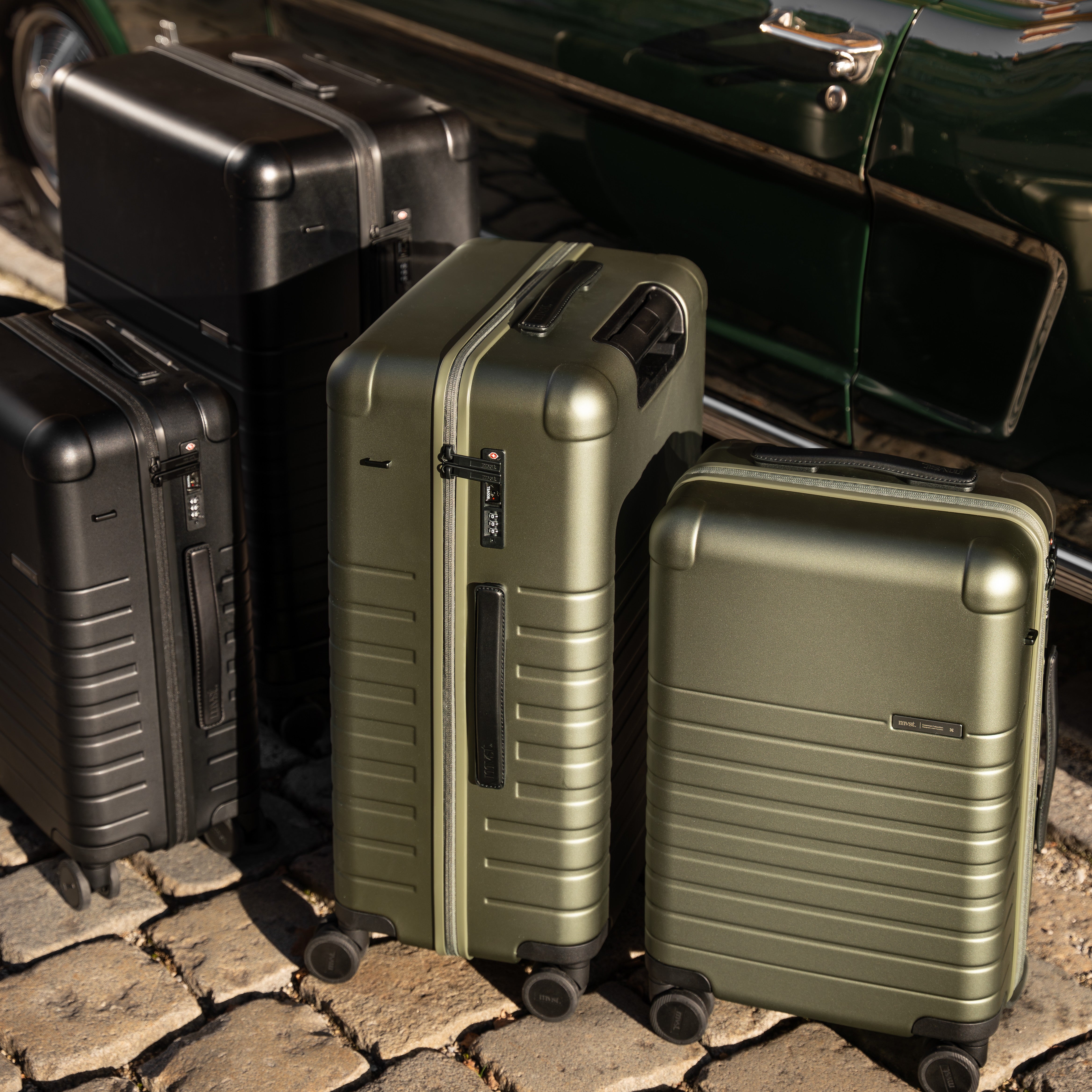
MVST Checked Luggage Examples

Two worked examples using current published dimensions. Neither is presented as airline approved; the arithmetic is shown so you can repeat it on whatever case you are considering.
| Product | Exterior dimensions | Linear total | Empty weight | Against a 62 in / 50 lb standard |
|---|---|---|---|---|
| TREVA Medium | 25.8 × 16.6 × 9.5 in; 62 L | 51.9 in | 11 lb / 5 kg | 10.1 in of size headroom. Leaves 39 lb of allowance |
| TREVA Large | 29.9 × 20.5 × 11.4 in; 97 L | 61.8 in | 13.78 lb / 6.25 kg | 0.2 in of size headroom. Leaves 36.22 lb of allowance |
The large case is the one to watch, and the number makes the point better than any warning would. At 61.8 in empty it sits a fifth of an inch inside a 62 in standard, and a packed case with a bulging lid measures more than an empty one. Full figures are on the TREVA size specifications page. Measurements include the wheels, which is the basis airlines use.
Pre-Flight Checked Bag Checklist

- Measure the packed bag at its outermost points and add the three figures.
- Weigh the packed bag at home. A luggage scale costs less than one overweight fee.
- Check the allowance for every operating carrier on the itinerary, and note that the US Department of Transportation advises against overpacking because it strains the latches.
- Move dense items into your carry-on if the checked bag is marginal. Weight moves; dimensions do not.
- Keep in mind that checked bags are screened and could be opened, so pack according to the the TSA's guidelines for prohibited and restricted items.
Conclusion
The right checked suitcase is the one that fits the airline's size and weight requirements and has sufficient space for the journey. Test size and weight separately, remove both. Determine the length of the packed bag (in linear inches), then weigh it at home and check the current rules for each airline on the route before traveling.
FAQs
What is the standard checked luggage size?
62 linear inches, or 158 cm, is the most common ceiling among US carriers, measured as height plus width plus depth added together. It is a convention and not a global standard. It can be changed by the route, fare, cabin and carrier and there is a limit on the individual sides for some carriers. Look into the airline that will be carrying you.
How much does a checked bag usually weigh?
The standard limit is 50 lb or 23 kg, and is often 70 lb or 32 kg with elite status or premium cabins. But, more important is what the empty case removes from it. If you have a 13.78 lb suitcase with a 50 lb allowance, that means that you have 36.22 lb of space for your things, not a bigger allowance.
Is 28-inch luggage too big for international checked baggage?
Typically, no, but it depends on the height as well.
- 28 inches is for height only. The total of all three sides is the limit.
- Include height, width and depth and compare to 62 in or 158 cm
- Many 28 inch cases are clear, some do not depend on width & depth.
- Weigh it too. If a 28 in case is too large then it can be overweight.
What are 62 linear inches in luggage size?
It is NOT a single exterior measurement but rather the sum of all three. Take out the dimensions (height, width and depth) at the outermost points such as wheels and handles and then add them together. A 29 by 20 by 12 in case has a total linear measurement of 61 in, and a limit of 62 in. A 30 by 21 by 12 in case totals 63 and does not.
Can I carry 30 kg in two bags?
Yes, typically, when you have two checked bags and each is under the limits set for each bag. Allowances are per piece not pooled – 15 kg in two bags is okay, 30 kg in one bag would be overweight against a 23 kg limit. Make sure that the fare you're paying covers a second bag; an overweight fee might be more expensive.
What happens if my checked luggage is overweight?
Over a specified limit, the bag is not accepted, but an overweight fee is paid: American will not accept checked bags exceeding 100 lb or 45 kg on their operated flights. A simple solution at the counter is to put heavy items into your bag or your carry-on.
Do wheels count in checked luggage measurements?
Yes. Airlines measure the outside of the packed bag, including wheels, fixed handles and anything that protrudes. Use the full exterior figures rather than shell-only measurements, and check the measurement note on your carrier's page, since the wording is what controls.
What size suitcase is best for international travel?
A medium checked case suits most international trips better than a large one.
- Medium sits comfortably inside a 62 in standard with room to spare
- Large starts close to the line and needs remeasuring once packed
- On a 23 kg allowance the weight usually runs out before a large case is full
- Check the piece and weight rules for every carrier, since these vary more than size limits do
How can I avoid oversize and overweight baggage fees?
Five things, in order of how much they help.
- Buy a case whose linear total leaves real margin under your usual carrier's limit
- Weigh the packed bag at home before you leave
- Choose a lower empty weight, which buys back allowance on every trip
- Split dense items across two bags if your fare includes two
- Check the current rules for every operating carrier, 24 to 48 hours before departure
Sources
Sources and references
- [1]American Airlines, Oversize and overweight bags, American Airlines. Checked bags over 100 lb / 45 kg are not accepted on American-operated flights; excess bags are charged the overweight fee from 50 lb / 23 kg up to 70 lb / 32 kg; premium cabins and elite tiers carry higher per-bag allowances. Verified 16 September 2026.
- [2]Delta Air Lines, Baggage Policy and Fees, Delta Air Lines. Standard checked bag under 50 lb / 23 kg with total dimensions not exceeding 62 in / 158 cm, measured as length plus width plus height. Fare, cabin and route exceptions apply. Verified 16 September 2026.
- [3]US Department of Transportation, Plane Talk, Tips on Avoiding Baggage Problems, Office of Aviation Consumer Protection, US Department of Transportation. Advises against overpacking checked bags because it puts pressure on the latches and makes them easier to spring open. Accessed 16 September 2026.
- [4]US Department of Transportation, Lost, Delayed, or Damaged Baggage, Office of Aviation Consumer Protection, US Department of Transportation. Airlines are responsible for damage occurring while a bag is under their control, subject to liability limits, and are not responsible for damage caused by improper packing. Accessed 16 September 2026.
- [5]Transportation Security Administration, Travel Tips, baggage screening, US Department of Homeland Security. Checked baggage is screened and may be opened for inspection. Cited for packing and prohibited-items context only; TSA does not set airline size or weight limits. Accessed 16 September 2026.
Stay in the know
Sizing updates, packing systems, and the deals we think are worth it. No more than twice a month.
By clicking submit, you agree to our Privacy Policy.