


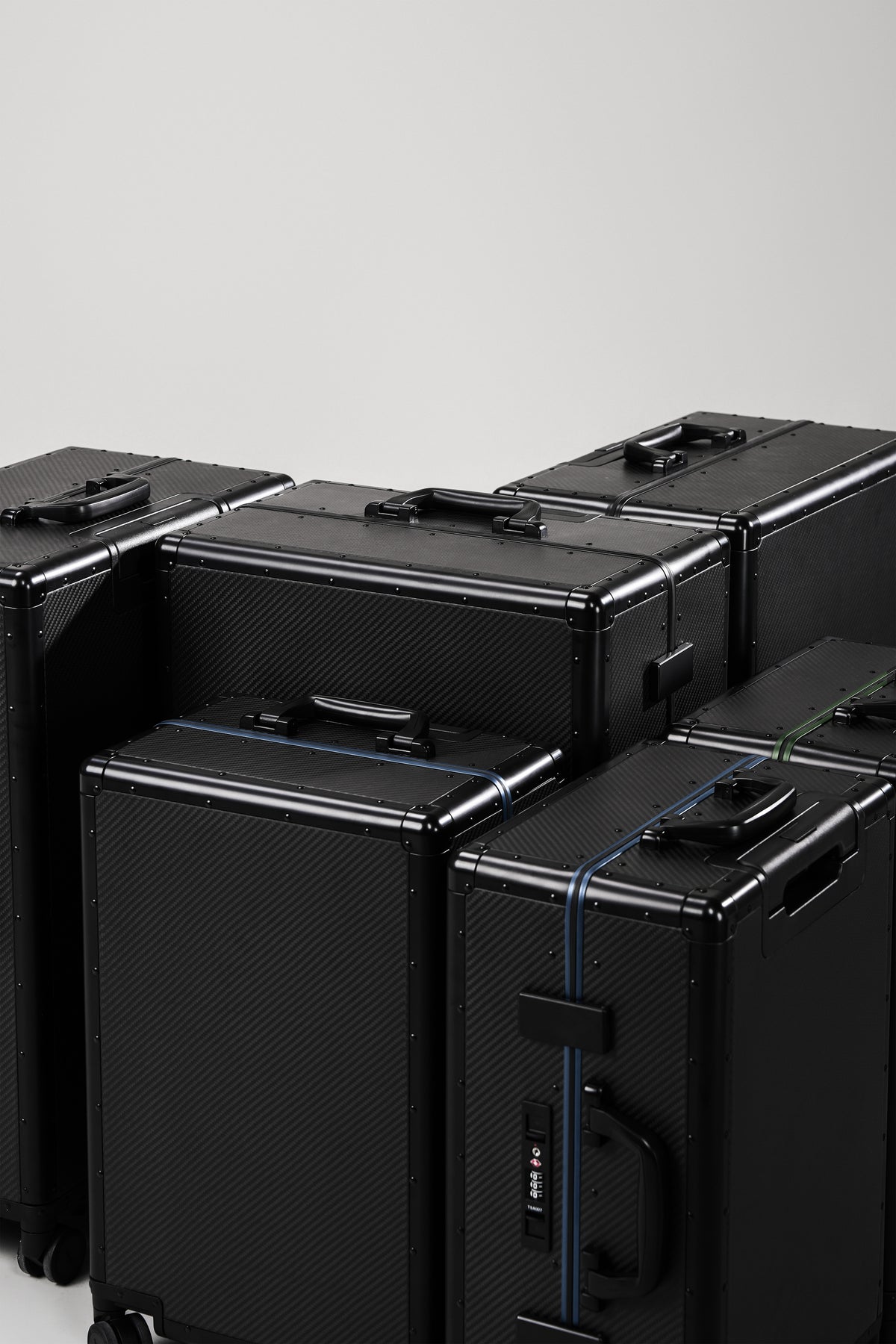
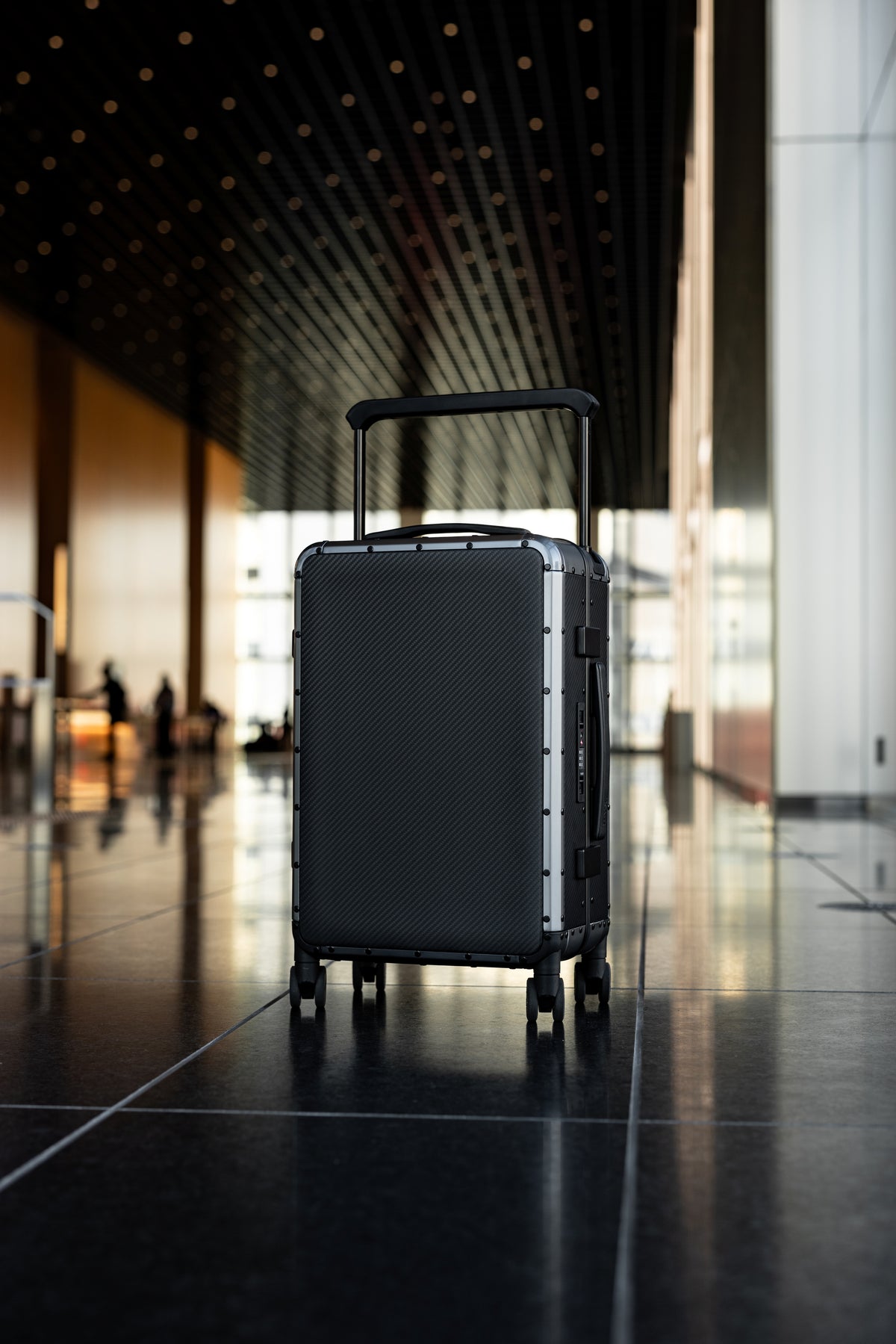

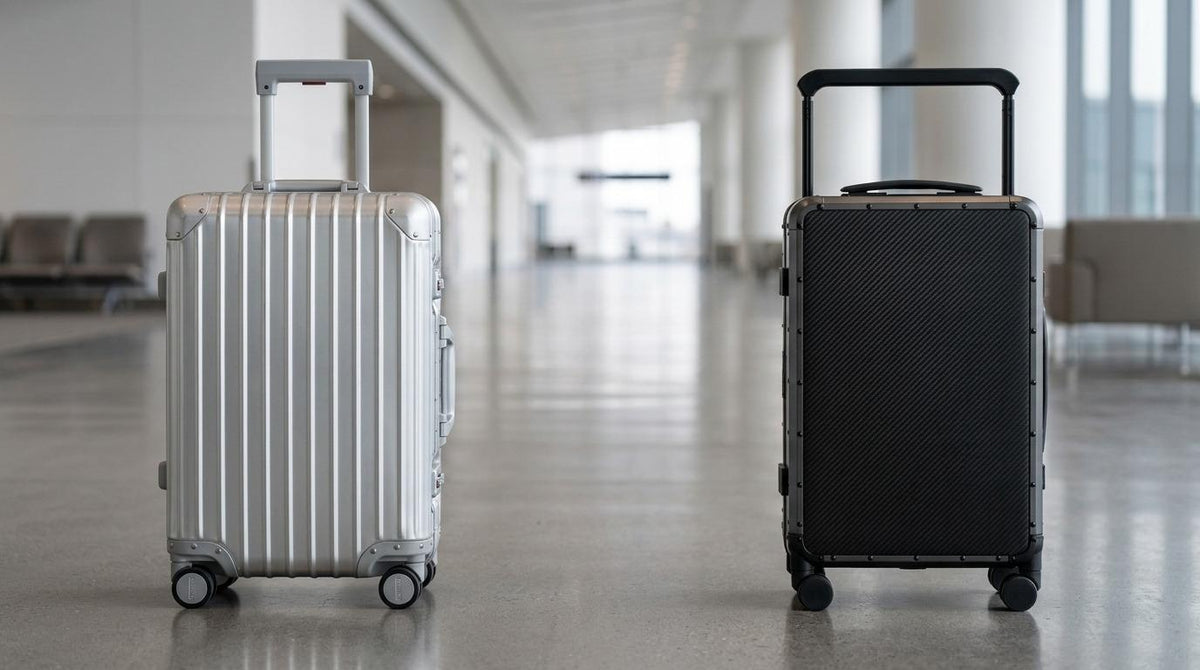

Buy aluminum if this is your first zipperless hard-shell case and you want something classic, practical and easy to judge. Consider carbon fiber if material innovation, individuality, craftsmanship and a more distinctive premium object matter more to you. Neither material wins every measure. Finished weight, durability, security and price all come from the complete suitcase, not the shell label. For frequent business travel, what decides it is airport handling, overhead lifting, short-trip packing and how you want the case to look in front of a client. Our guide to business trip luggage for one to three nights covers the packing side.
If the second description sounds like you, MVST's carbon fiber luggage is where to start looking.
Carbon Fiber vs Aluminum Luggage at a Glance
The table below compares why buyers are drawn to each material before it touches any technical trade-off. Read the weight, durability and security rows as model-specific rather than as verdicts. Both materials appear in premium hard-shell luggage for good reasons, and those reasons are different.
| Business-travel factor | Carbon fiber luggage | Aluminum luggage |
|---|---|---|
| Primary appeal | Modern composite engineering, distinctive weave and texture, individuality, a specialised premium feel | Classic premium metal shell, familiar hard-shell identity, straightforward and established |
| How it is built | A composite shell of layered fibers in resin, often combined with a metal frame and reinforcements | A formed aluminum-alloy shell with a frame, corners, hardware and closure system |
| Visual character | Technical weave with depth and texture. Less conventional in luggage | Metallic surface where dents, scuffs and patina can become part of the look |
| Craft and manufacturing | Layering, moulding and curing, trimming, joining and finishing can be more process-intensive | Alloy selection, forming, machining, joining and finishing produce the metal case |
| Finished carry-on weight | Can be light, but not automatically. Compare the exact model | Can be substantial in rigid framed models. Compare the exact model |
| Durability | Depends on laminate, resin, thickness, frame, joints and where the impact lands | Depends on alloy, temper, thickness, geometry, frame and load |
| Security | Zipperless latch systems are available. Security is model-specific | Zipperless latch systems are common. Security is model-specific |
| Price | Often a niche premium category. Manufacturing and finishing contribute to higher pricing | A wider range, from mid-premium to luxury |
| Best fit | A buyer who prioritises innovation, material aesthetics, individuality and premium detail | A first-time premium zipperless buyer who prioritises practicality, familiarity and classic metal construction |
What Carbon Fiber and Aluminum Luggage Actually Are
Carbon Fiber Is a Composite System
Carbon fiber is not a metal or a plastic on its own. Thin carbon filaments are woven into cloth, set in resin, then built up in layers to form a shell. It gets used where stiffness matters for a given weight. Aerospace parts, motorsport, sporting goods, specialised kit. That heritage tells you where the material came from. It does not prove a suitcase made from it performs better.
Aluminum Is a Metal Alloy System
Aluminum is a light metal alloy used across transport, boats, buildings and formed cases. Alloys are named by what is in them and how they are treated, and the Aluminum Association has run that naming system since 1954. A published alloy and temper tells you something real. Loose phrases like aircraft-grade do not. Treat those as marketing.
How Luggage Uses Each One
Carbon-fiber luggage usually pairs composite shell panels with a metal frame. Aluminum luggage usually uses formed alloy panels with a rigid frame and latches. The design levers differ. For carbon fiber they are the layup, the fiber direction, the resin and the finish. For aluminum they are the alloy, the temper, the forming and the frame.
NASA puts the core difference plainly. Metals are the same all the way through, so they behave the same in every direction. Composites are not. Their properties can be aimed at where the load goes. That tailoring is the whole point of a composite. It is also why you cannot reduce a composite shell to one strength number.
How MVST Uses the Two Materials
-
Carbon S 2.0
Brand-stated construction is a carbon-fiber shell on a 6-series anodized aluminum frame. So it is a deliberate hybrid, not a case made purely of composite. The shell panels carry the material identity. The metal frame carries the closure and the structure. The Carbon S 2.0 construction and specifications list a 40 L carry-on at 11.2 lb, from $885.
-
TREVA
Brand-stated construction is a 5083-O aluminum alloy shell in a zipperless framed suitcase. The TREVA carry-on specifications list a 34 L carry-on at 9.37 lb, from $399.
-
What They Share
Both use zipperless closure concepts with TSA-approved or TSA-compatible locks. That matters for the security question later, because it shows closure security is not something one shell material owns.
-
Where the Experience Differs
You experience Carbon S 2.0 through the visible weave, the surface of the material itself and the Alter-Nappa and Alcantara interior. You experience TREVA through a clean metal shell, the patina it picks up and a classic hard-shell character. Two different objects, chosen for different reasons.

Why You Would Choose Carbon Fiber

-
Innovation and Composite Engineering
A composite shell is built rather than formed. The layup, the fiber direction, the resin, the cure and the finish are all decisions. Each one changes the result. That is a richer engineering story than pressing a single sheet of metal, and it is the honest basis for calling the material innovative.
-
Craftsmanship in the Build
Good composite parts need controlled layering, moulding, curing, trimming, joining and finishing. Oak Ridge National Laboratory notes that making carbon fiber is slow and energy intensive, which keeps it out of cost-sensitive products. More steps, more control points, and a cost you see at retail.
-
The Weave and the Texture
On a real composite shell the weave is the material showing through the finish, not a printed pattern copying one. Whether you want that look is a matter of taste. It says nothing about strength, and it should not be sold as if it did.
-
Individuality
Carbon-fiber luggage looks less conventional than grooved aluminum. In an airport, a hotel lobby or a client meeting, it reads as a deliberate object rather than a familiar one. For some travellers that is the whole appeal.
-
The Interior Pairing
On Carbon S 2.0 the Alter-Nappa and Alcantara interior reinforces the premium feel. This is a product-design choice MVST made for that line, not a property of carbon fiber. A different composite case would have a different interior.
-
Performance Potential
Composites can offer real stiffness and strength for their weight. Whether a given suitcase delivers it comes down to the laminate, the frame and the hardware. So check the model, not the material.
Why You Would Choose Aluminum

-
A Classic Hard-Shell Material
Aluminum has been associated with rigid cases and premium metal luggage for decades. A buyer looking at one knows what they are getting, visually and structurally, without needing anything explained.
-
Straightforward Material Logic
The metal shell feels solid, rigid and direct. Dents, scratches and patina are familiar forms of wear, and many owners accept them as part of the look rather than as damage.
-
A Practical First Premium Upgrade
For someone entering the zipperless hard-shell category for the first time, aluminum is the easier recommendation when practicality, familiarity and a clear price step matter most. TREVA aluminum luggage starts at $399, which is a lower first commitment than the composite line. Our guide to what 5083-O aluminum is explains the alloy TREVA uses.
-
Broad Market Choice
Aluminum luggage comes in more price points and more brands than real carbon-fiber luggage does. That gives you more ways to compare size, warranty, wheels and after-sales support before you commit.
Why Weight, Durability and Security Do Not Crown a Winner
-
Weight
Raw composite density does not equal finished-suitcase weight. Compare exact dimensions, capacity, frame, lining, hardware and empty weight together. In the six models below, carbon carry-ons run 8.4 to 11.2 lb and aluminum runs 9.37 to 10.8 lb. The ranges overlap.
-
Durability
How carbon fiber behaves depends on the laminate and where the impact lands. How aluminum behaves depends on the alloy, the temper, the shape and the load. NASA researchers who study composite failure describe the difference well. Metals crack cleanly. Composites develop a damage zone, which can mean broken fibers, cracked resin or layers parting. That is different physics, not a ranking. Without controlled suitcase testing there is no universal winner.
-
Security
Zipperless frames and TSA locks exist in both materials, including both MVST cases above. The TSA explains that recognised locks let officers open a bag for inspection without cutting the lock where possible. It also says it is not liable for damage to locked bags opened for screening. That is inspection access, not a theft rating. No shell material changes it.
-
Repair and Service
Here the composite difference is practical rather than theoretical. A damage zone is harder to judge by eye than a dent. So check the warranty, the spare parts, the service network and how damage gets assessed on the exact model, whichever material you pick.
How a Frequent Business Traveler Should Choose
Turn the material difference into a match with how you actually travel.
| Your priority | Where to start | Why |
|---|---|---|
| First premium zipperless purchase | Aluminum | Established category, straightforward material story, broad comparison set, lower entry price |
| You want an uncommon material | Carbon fiber | Composite engineering, visible weave, a less conventional material identity |
| Premium tactile and interior experience | Carbon S 2.0 | Composite shell, metal frame and the Alter-Nappa and Alcantara interior treatment |
| Strict cabin weight limit | Compare exact models | No material shortcut. Finished weight and dimensions decide it |
| You check luggage often | Compare warranty and service | Repair pathway and parts availability matter more than the shell label |
| You dislike visible dents and patina | Carbon fiber may suit better | Aesthetic fit, though composite finishes scratch too and impact behaviour is model-specific |
| You like metal wear and classic character | Aluminum may suit better | Dents and scuffs are part of the expected look |
| Budget | Aluminum has more entry points | Carbon fiber is a niche premium category where lower-volume production lifts price |
One thing to settle before any of that: your airline's actual limits. The FAA notes that most carriers cap carry-ons around 45 linear inches and advises confirming with the airline you are flying, since the agency sets no bag size itself. Measure including wheels and handles, and weigh the case empty.
How to Compare Models Before You Buy
- Compare exterior dimensions with the wheels and handles included, because listings vary on this.
- Read empty weight and usable capacity together rather than separately.
- Check the shell and frame as a system, not the shell material alone.
- Check how the closure works, whether latch or zipper, and how the TSA lock is implemented.
- Inspect the wheels, the handle stages, the interior organisation and how the case handles a garment.
- Check current price, warranty exclusions, the repair process and whether replacement parts are available.
- Then ask yourself the question the specifications cannot answer: do you want classic metal character, or a more distinctive composite object?
Six Real Carry-Ons for Business Travel

Examples across the market spectrum, not a ranking. Sizes, capacities, frames, interiors and hardware all differ, so this is not a controlled comparison. Figures carried from the 3 September 2026 verification; recheck before publication.
| Product | Material and construction | Exterior and capacity | Weight | Closure and lock | Price | Why a buyer may consider it |
|---|---|---|---|---|---|---|
| MVST Carbon S 2.0 Carry-On | Carbon-fiber shell on a 6-series anodized aluminum frame (brand-stated) | 23 × 13.8 × 8.7 in; 40 L | 11.2 lb | Zipperless; TSA-approved combination lock | $885 | Carbon weave with hybrid carbon and metal construction; Alter-Nappa and Alcantara interior |
| MVST TREVA Carry-On | 5083-O aluminum alloy shell (brand-stated) | 21.7 × 14.8 × 8.7 in; 34 L | 9.37 lb | Zipperless frame; TSA-approved locks | $399 | Classic aluminum-shell experience at the lowest MVST hard-shell entry price |
| monCarbone BLACKDIAMOND | Carbon-fiber shell with aluminum frame | 365 × 230 × 555 mm; 39 L | 8.8 lb | Verify current lock detail | $1,650 | A lighter finished carbon-fiber carry-on with metal-frame construction |
| TecknoMonster Davis Cabin S | Carbon-fiber shells; aluminum and leather handles | 54 × 37 × 21 cm; 33 L | 8.4 lb | Zipper closure; TSA lock | $3,595 | Carbon fiber at the artisanal end of the market. Stock was unavailable at last check |
| RIMOWA Original Cabin | Anodized aluminum | 21.7 × 15.8 × 9.1 in; 35 L | 9.5 lb | TSA-approved locks | $1,550 | The established luxury aluminum reference point |
| Carl Friedrik The Carry-on (Aluminium) | Anodised aluminum shell | 21.7 × 15 × 9.1 in; 41 L | 10.8 lb | Combination locks | $945 | A design-led aluminum alternative with leather detail and a rigid frame |
The weights are the useful part. Carbon appears at both the lightest and the heaviest ends of this set, and so does aluminum in the middle of it. Design decisions, not the shell material, produced that spread.
Conclusion

Two materials, two reasons to buy, same premium hard-shell brief. Aluminum is the logical first recommendation if you want a classic, practical zipperless hard-shell case you can judge easily. Carbon fiber is the compelling alternative if material innovation, composite craftsmanship, distinctive aesthetics and premium interior detail carry more weight with you. Look at the MVST carbon fiber collection for the composite shell, the weave and the leather-lined interior, or the TREVA aluminum collection for the classic metal case at a lower entry price.
FAQs
Which is better, aluminum or carbon fiber luggage?
Neither is universally better. Aluminum is the more conventional first choice for practical premium hard-shell travel: a familiar category, a straightforward material story and a wider set of models to compare. Carbon fiber is the more distinctive choice for buyers who value composite engineering, material aesthetics and individuality. The two materials are not two grades of the same product, so the useful question is which experience fits how you travel rather than which material scores higher.
Why choose carbon fiber luggage if aluminum is less expensive?
Because you are buying a different object. Carbon fiber earns its place through material innovation, a distinctive woven surface, more specialised composite manufacturing, premium finishing and product-specific interior details. On MVST's lines that is a $885 starting price against $399. Whether the difference is worth it depends on how much those things matter to you, and the price should always be judged against the finished model rather than the raw shell material.
Is carbon fiber good for luggage?
Yes, when the composite shell, frame, joining and hardware are well engineered. Its appeal includes high stiffness and strength potential for its weight, plus a material identity that stands out. The label on its own guarantees nothing though. It does not promise lower weight and it does not promise greater impact resistance, because both of those come from the specific laminate, frame and hardware. Check the model, not the material.
What are the disadvantages of carbon fiber luggage?
Higher price is the most consistent one, along with more specialised damage assessment and repair, and sensitivity to localised impact depending on how the laminate is designed. NASA composite research explains why: composites develop a damage zone rather than a clean crack, which is harder to judge by eye. Treat these as trade-offs rather than as a verdict. They are the cost of the properties that make the material appealing in the first place.
What are the disadvantages of aluminum suitcases?
Many full-aluminum cases are relatively heavy, show dents and scratches readily, have very little shell flex when you have overpacked, and can be expensive. Some travellers actively like the patina an aluminum case develops and treat it as part of the appeal. Others would rather have a cleaner composite finish that stays looking newer. Neither preference is wrong, and it is worth knowing which one you hold before you spend the money.
Which is lighter, carbon fiber or aluminum luggage?
Raw carbon-fiber composites can have lower density than aluminum, but finished luggage weight depends on size, capacity, frame, hardware, interior and construction. In the six models above, carbon carry-ons range from 8.4 to 11.2 lb and aluminum from 9.37 to 10.8 lb, so the ranges overlap and the lightest and heaviest cases are both carbon. Compare the published empty weight of the exact size you want.
Which is more expensive, carbon fiber or aluminum luggage?
Carbon-fiber luggage sits mostly at the niche premium end, while aluminum spans a wider range. In the set above, carbon runs $885 to $3,595 and aluminum runs $399 to $1,550. Do not assign that whole gap to the shell material, though. Brand positioning, frame and hardware, interior materials, warranty terms and production volume all move the price, and two cases in the same material can be thousands of dollars apart.
Is aluminum the better first zipperless hard-shell suitcase?
Often yes, if you are prioritising a familiar premium category, practical pricing and straightforward rigid-metal construction. You will find more models to compare, more price points and a wear pattern most buyers already understand. That is a recommendation about buyer fit rather than proof that aluminum is technically superior. If you already know the zipperless format suits you and you want something more distinctive, starting with carbon fiber is a perfectly reasonable decision.
Is carbon fiber suitable for frequent business travel?
It can be, and it appeals particularly to travellers who want a distinctive, carefully considered object for repeated client-facing trips. What decides it is the specific model. Check the finished weight against the cabin allowances on your routes, the exterior dimensions with wheels included, the wheel and handle quality for airport surfaces, the closure and lock, and the warranty and service pathway. If those fit your travel, the material is not a barrier.
How should I choose between carbon fiber and aluminum for business travel?
Choose aluminum for classic practicality and a familiar metal-shell experience, especially on a first zipperless purchase. Consider carbon fiber for innovation, individuality, weave and texture, and premium material detail. Then verify the finished weight, exterior dimensions with wheels and handles, usable capacity, closure and lock design, wheel and handle quality, and the warranty exclusions and repair process on the exact model. The specifications settle the practical questions; your preference settles the rest.
Sources
Sources and references
- [1]NASA, State of the Art of Small Spacecraft Technology, Structures, Materials and Mechanisms, NASA Ames Research Center. Metals are homogeneous and isotropic; composites are inhomogeneous and anisotropic, allowing properties to be tailored to load paths. Accessed 3 September 2026.
- [2]Merlin Theodore, PhD, group leader, Advanced Fibers Manufacturing Group, and director of the Carbon Fiber Technology Facility, Oak Ridge National Laboratory. Carbon fiber properties, production cost and manufacturing energy intensity. Accessed 3 September 2026.
- [3]NASA Technical Reports Server, Global Failure Modes in Composite Structures, NASA Langley Research Center. Metals fracture with clean cracks while composites develop a damage zone involving fiber breakage, matrix cracking and delamination. Used for failure-mode difference, not for ranking materials. Accessed 3 September 2026.
- [4]John Weritz, vice president for standards and technology, The Aluminum Association. Wrought alloy and temper designation system. Accessed 3 September 2026.
- [5]Transportation Security Administration, Travel Tips, baggage and recognised locks, US Department of Homeland Security. Recognised locks allow inspection without cutting where possible; TSA is not liable for damage to locked bags opened for screening. Accessed 3 September 2026.
- [6]Federal Aviation Administration, Carry-On Baggage Tips, Office of Aviation Safety, US Department of Transportation. Carry-on size guidance and the instruction to confirm limits with the operating airline. Accessed 3 September 2026.
Stay in the know
Sizing updates, packing systems, and the deals we think are worth it. No more than twice a month.
By clicking submit, you agree to our Privacy Policy.