


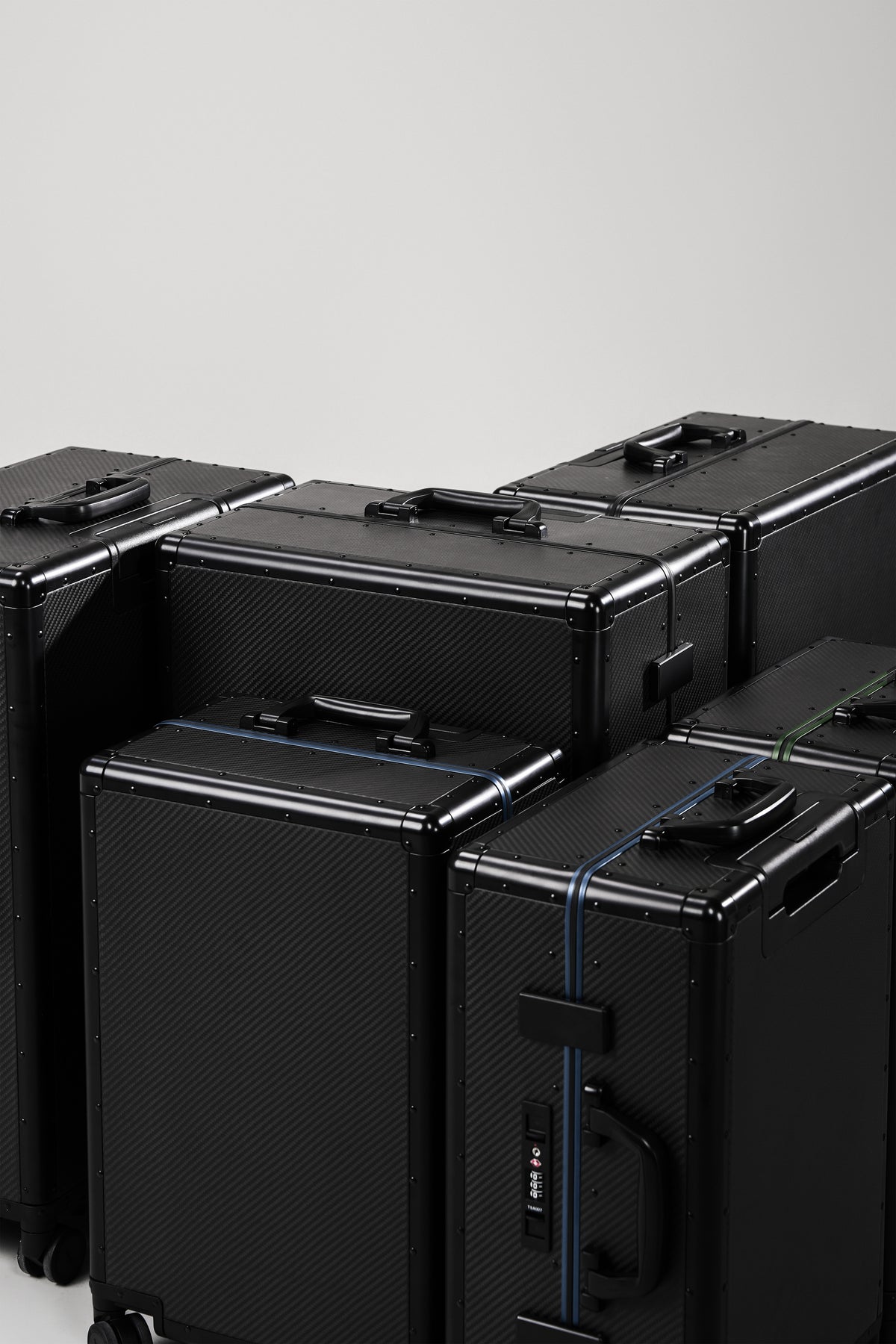
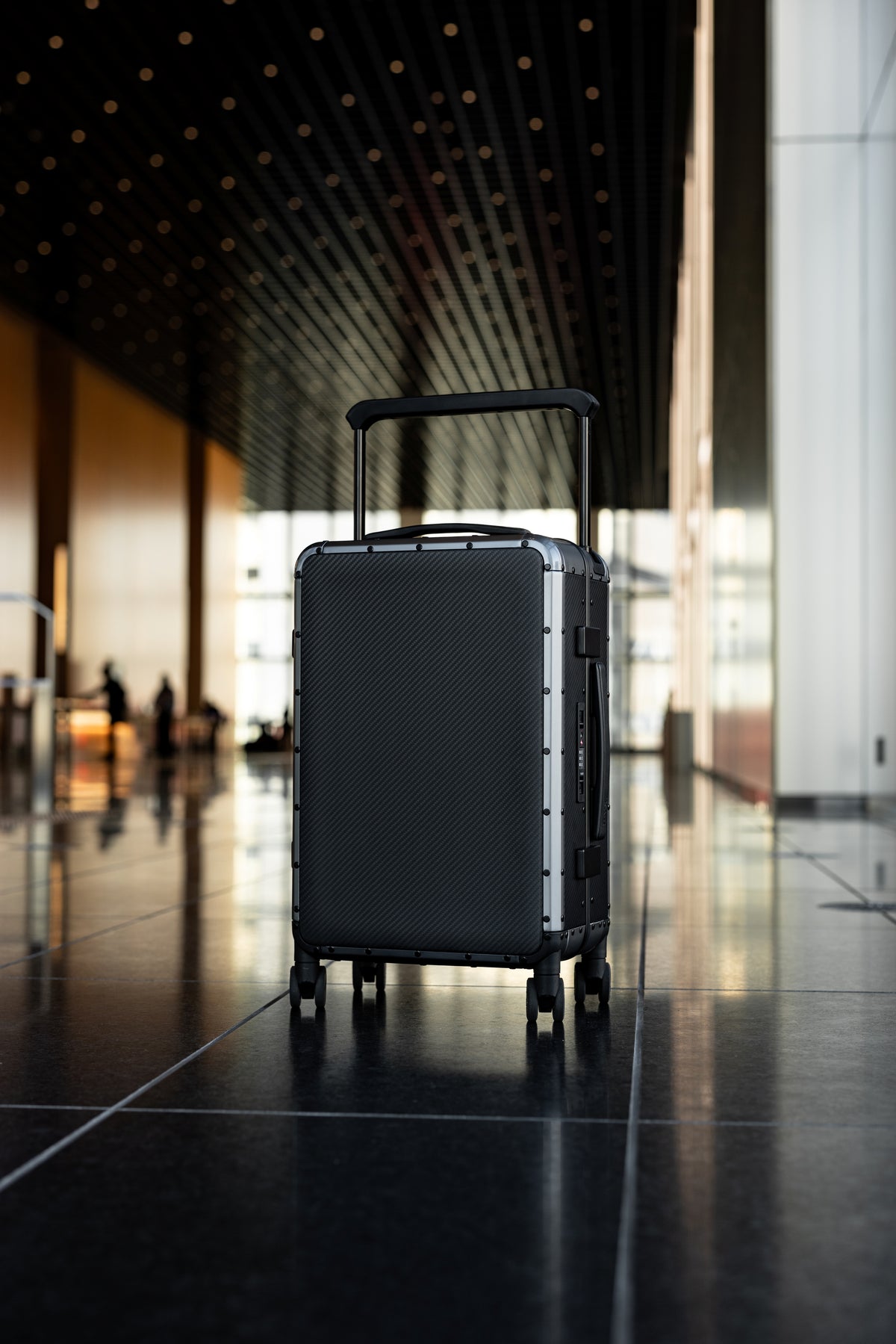



Carbon fiber luggage is built from one of the most engineered materials you’ll find in a suitcase. The shell isn’t a single substance. It’s a composite: carbon filaments, each far finer than a human hair, woven into fabric, set in a polymer resin and cured into a stiff, structured panel. The fibers carry the load, the resin holds them in place, and the way the layers are stacked decides where the shell is strongest.
That’s where carbon gets its character. You get high stiffness for the weight, a weave you can actually see, and a manufacturing process that still relies on careful handwork. It’s also why genuine carbon fiber luggage is still fairly rare.
MVST's Carbon S 2.0 is a current example of carbon fiber luggage, and its specifications appear alongside three other carbon-fiber cases further down.
Carbon Fiber Luggage Material at a Glance
A carbon fiber suitcase is a set of parts working together. Here’s what each one does, and what’s worth asking about on a specific model.
| Component | What it is | What it can affect | What to verify for a named suitcase |
|---|---|---|---|
| Carbon fiber reinforcement | Fibers, tows, woven fabric or tape that reinforce the composite | Directional stiffness and strength potential, plus the visible fiber pattern | Fiber form or supplier specification. Do not infer it from appearance |
| Resin matrix | The polymer that binds the fibers and transfers load between them | Impact behaviour, toughness, processing and how repair is approached | The resin family, from the supplier or product master |
| Layup and orientation | The number, sequence and direction of composite plies | Directional properties, local stiffness and impact response | An approved layup description. No guessed ply count or angles |
| Shell geometry and thickness | The shape and material section of the finished shell | Local stiffness, deformation and weight | Verified thickness or range, and where it was measured |
| Frame and joints | The perimeter structure and how the shell connects to it | Closure alignment, overall stiffness and load transfer | Frame alloy and finish, joint design, original construction evidence |
| Hardware | Locks, wheels and handles | Finished weight, mobility, security and serviceability | Current product page. Do not credit shell material for hardware quality |
| Interior | Lining, dividers and organisation | Finished weight and user experience | Current product page. A product-design choice, not a material property |
What Is Carbon Fiber Luggage Material?

Carbon Fiber Is the Reinforcement
Fine carbon filaments are collected in tows, which are made into unidirectional tape or other reinforcement products, or woven into fabric. These fibers individually don't make a suitcase shell. They are the portion that supports the load along its length.
The Resin Matrix Makes It a Composite
The fibers are surrounded by a polymer resin. It keeps them together, transfers load between them and provides shape to the laminate. It's a straightforward rule, according to The Federal Aviation Administration. A composite is a combination of 2 or more materials with very different properties, and the composite material has properties that neither of the materials alone could have.
CFRP Is the More Precise Term
The true name of the finished shell material is carbon-fiber-reinforced polymer or CFRP. It's good to know, as many of the variations that distinguish one carbon shell from another have to do with the resin, and with how the layers are constructed, rather than with the fibers themselves.

How a Carbon Fiber Shell Is Made
Most luggage shells are formed in one main step. Plastic is molded, or aluminum is pressed. A carbon shell undergoes a number of distinct stages and each one requires control and time.
From Precursor to Fiber
Carbon fiber is originally made from something else. It is primarily composed of polyacrylonitrile (PAN) – a type of acrylic. According to The US Department of Energy, the precursor is initially oxidized in very large ovens which require a lot of energy. The stabilized fiber is then heated again, without oxygen, until what remains is almost pure carbon.
Weave and Fiber Form
The filaments are then bundled together into tows and either woven into fabric or extruded as unidirectional tape. When people think of carbon, they tend to think of a checked or twill surface, which is what woven fabric is. Tape all fibers up in one direction. Both are in place, and the motif on the exterior is a hint to the motif of the interior fibers.
Layup and Orientation
Next, layers called plies are stacked at chosen angles. NASA describes composites as inherently anisotropic, which means their properties can be tailored to the direction loads come from. That’s the real engineering advantage of carbon. A designer can make a suitcase strong where it is needed most and a multi-directional layup allows the shell to take hits from multiple directions.
Resin and Curing
The stack is combined with resin and cured under heat and pressure, in a mold, an autoclave or a press. Thermoset and thermoplastic resins are processed differently, and impart a slightly different character to the laminate. The curing process is where the plies are joined into a single solid panel and is a factor that distinguishes between a well-made shell and a hurried shell.
Trimming, Finishing and Joining
After curing, the shell is trimmed, finished and fitted to its frame and hardware. Much of that is still done by hand, which is part of why no two makers’ carbon cases look or feel quite the same.
Why Carbon Fiber Is Still Rare in Luggage
Walk through any airport and you’ll see rows of polycarbonate and the odd aluminum case. Genuine carbon fiber is a lot more difficult to find, and there are valid reasons for that.
However, the production of carbon fiber takes a long time and requires a lot of energy, excluding it from cost-sensitive products, says the Oak Ridge National Laboratory. Once that fiber turns to suitcase shell, then comes layup, curing and finishing time. When industry reports on carbon luggage, it's usually about the hand-crafted nature of the luggage, as opposed to the high volume molding that takes place with most suitcases.
Therefore the category remains small, in nature. There are fewer brands that actually offer true carbon shells, shorter production runs, and more hands-on work involved in a molded suitcase than a true carbon shell. The rare is a part of the appeal for those who enjoy owning something that is made that way.
Not All Carbon Fiber Luggage Uses the Same Material System
Four things are sold with the same word. If you know what they are you can tell the genuine from the fake.
- Continuous-fiber CFRP shell. Carbon reinforcement in a polymer matrix, normally a thermoset. There is still a wide range of construction options available for different laminates.
- A composite made of carbon fibers in a thermoplastic resin, like polycarbonate. The Chinese brand Tuplus is a documented case of a carbon-fiber-reinforced polycarbonate luggage system with an aluminum-magnesium frame, which is made using Covestro's Maezio material. The results it reports (drop, tumble, falling-ball) apply to that particular system and are not transferable.
- The combination of shell and frame structures. Carbon-fiber shell panels, aluminum/composite perimeter frame and metal hardware. This is the true essence of quality carbon fiber suitcases.
- Carbon-look finish. Printed, wrapped or moulded pattern with the appearance of weave. It's not structural carbon fiber and should not be called carbon fiber luggage.
Carbon Fiber Shell and Aluminum Frame, Why Hybrid Construction Matters

The shell does not work alone. The Carbon S 2.0 construction is brand-stated as a carbon-fiber shell on a 6-series anodized aluminum frame, with a zipperless closure and a TSA-approved combination lock. monCarbone's BLACKDIAMOND aluminum-frame model uses the same broad architecture: composite shell panels, metal frame.
Pairing the two plays to each material’s strengths. The carbon shell provides the case with its rigidity and appearance, and a precision-machined aluminum frame provides the opening with an exact edge that the lock and latches close to. A well made hybrid case considers the entire case as one engineered product, from frame alignment, through the wheel and handle mounts, to the joints between shell and frame.

Why Carbon Fiber Luggage Feels Different in Everyday Travel

Material Aesthetics
On a carbon shell, the weave isn’t a pattern printed on top. It’s the material itself, showing through the finish. It catches light differently from anodized metal or molded plastic, and it reads as quietly technical rather than flashy. For a lot of owners, that’s the main reason to choose it.
Stiff, Structured Feel
If the case is well made, pick it up and it is stiff and well braced, the panels have very little give in them. The stiffness of the laminate varies according to the laminate, but this is generally the first characteristic that people notice.
Stiffness for Its Weight

Carbon composites are known for how much stiffness and strength they offer for their weight. This is shared with the frame, wheels, handle and lining and the finished weight will depend on the size and the level of fit out. Look at the published weight of the size you want to purchase. MVST’s Carbon S 2.0 Carry-On, for example, is listed at 11.2 lb with 40 L of space.
Interior and Detail Pairing
Carbon cases usually sit at the top of a brand’s range, and the interiors tend to reflect that. Carbon S 2.0, for instance, pairs its shell with an Alter-Nappa and Alcantara interior and offers customization options.
Who Carbon Fiber Luggage Is For

Carbon fiber luggage isn’t trying to be everyone’s default suitcase. It suits a particular kind of traveler, and if you see yourself below, it’s worth a closer look.
- People who already love carbon elsewhere. You know the stuff if you drive a car with carbon trim, ride a carbon road bike or wear a carbon watch. A carbon suitcase is what gives a traveling experience the same feel and look.
- Travelers who value craft. Some buyers will have preferences on how something is made, and it is the same here. They like to be made aware that each shell is being laid, cured and finished in stages.
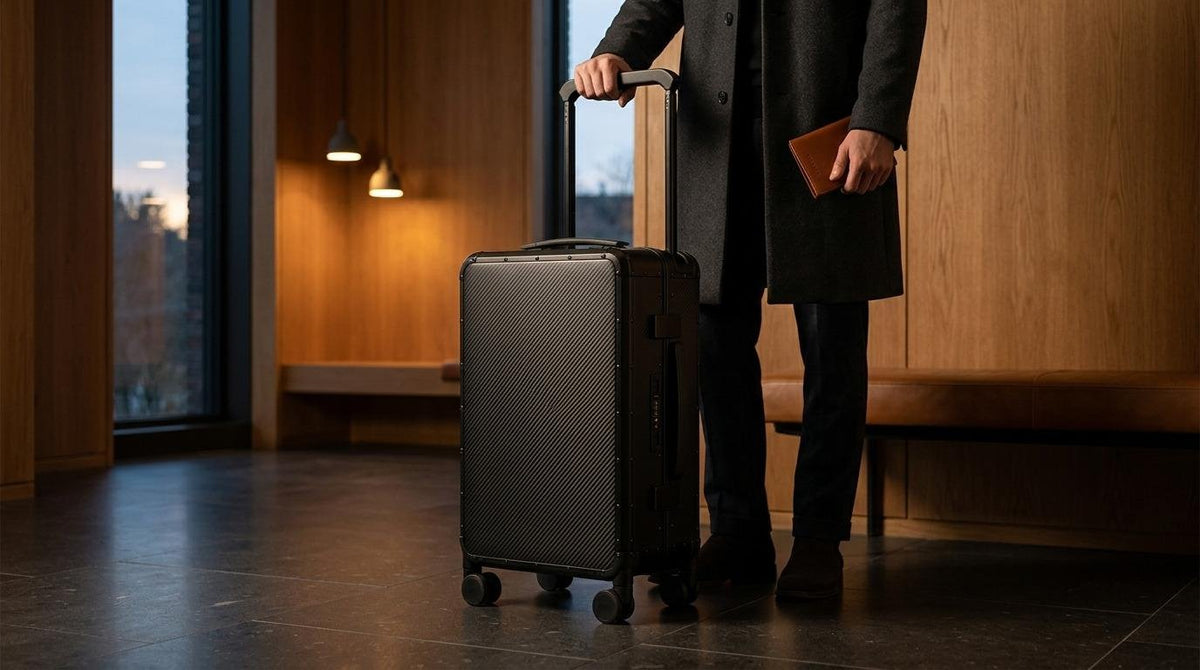
- Frequent business travelers who want structure. A framed and rigid carbon case maintains its form, snaps shut and appears put together in a hotel lobby or heading into a meeting. Our guide to business trip luggage for one to three nights covers what to pack.
- People who prefer understated to loud. Carbon has a low-key, technical presence. It stands out to people who know what it is, without a logo doing the work.
- Owners who keep things for years. Carbon cases are a nice touch, and those who think of luggage as something that should be used over a long period of time rather than just for the season reap the rewards.
If you're looking for the lowest possible price, you might want to consider using a polycarbonate case. That’s a different brief, not a better one.
How Carbon Fiber Luggage Holds Up
Strength Where It’s Designed to Be
Because composites are anisotropic, a carbon shell’s stiffness and strength follow the direction of its fibers and the way its plies are stacked. That’s what lets designers reinforce the areas a suitcase needs most. It’s also why a loose claim that carbon is some multiple stronger than steel doesn’t tell you much. The real story is in the layup.
Everyday Wear and Care
Light scratches and marks in the finish are cosmetic, as they are on any shell. After a hard knock, it’s sensible to check that the latches close, the perimeter gap is even and the wheels and handle work, and to look at the inside of the panel as well. MVST’s warranty policy sets out how defects and normal wear are handled.
Carbon Fiber vs Aluminum vs Polycarbonate
Each material has its own personality. Here’s how carbon compares with the two you’ll see most often. For aluminum and polycarbonate in more depth, see aluminum vs polycarbonate luggage.
- Carbon fiber composite: an engineered laminate with high stiffness for its weight, a visible weave and a small-batch, craft-heavy build. The most distinctive of the three, at a premium price.
- Aluminum: a classic rigid metal shell that wears in with visible character, in a well-established framed-luggage category. TREVA aluminum luggage is MVST’s example.
- Polycarbonate: an extruded thermoplastic which is more flexible in many shapes, typically the least expensive and most available.
The right choice depends on your preference for the material, its appearance with age, the cost, or the range of choices available.
How to Tell Real Carbon Fiber From a Carbon-Look Finish
- Look for an explicit shell-material specification rather than carbon style, carbon effect or carbon pattern.
- See if the brand names four things: reinforcement, matrix or composite, frame material and manufacturing technique.
- Treat a visible weave as a clue. It does not certify fiber grade, ply count, orientation and structural performance.
- Look for brands that include finished weight, exterior dimensions, capacity, warranty and service information with the material claim.
Real-World Carbon Fiber Luggage Examples
Four authentic carbon fiber cases, each slightly different. These are examples only and sizes, frames and interiors vary. Verified 12 September 2026.
| Product | Material and construction | Exterior and capacity | Weight | Closure and key details | Price |
|---|---|---|---|---|---|
| MVST Carbon S 2.0 Carry-On | Brand-stated carbon-fiber shell on a 6-series anodized aluminum frame | 23 × 13.8 × 8.7 in; 40 L | 11.2 lb | Zipperless; TSA-approved combination lock; Alter-Nappa and Alcantara interior; customization available | $885 |
| Simply Carbon Fiber Classic Series | Brand-stated real matte carbon fiber and aluminum | 21.5 × 13.8 × 9.4 in | About 9 lb | Trunk-style 50/50 opening; two TSA integrated locks; four dual-spinning wheels | $634.99 sale, $849.99 regular |
| monCarbone BLACKDIAMOND Aluminum Frame | Carbon-fiber shell with an aluminum frame | 365 × 230 × 555 mm; 39 L | 8.8 lb | Aluminum-frame version; verify current lock and hardware wording | $1,650 |
| TecknoMonster Davis Cabin S | Brand-stated 100 percent carbon-fiber shells; aluminum and leather handles | 54 × 37 × 21 cm; 33 L | 3.8 kg, about 8.4 lb | Zipper closure; TSA lock; bull-leather corner protectors | $3,595; Cabin S sold out at verification |
The price spread, from about $635 to $3,595, says a lot about the category. Shell construction, finishing, interior materials and the amount of handwork in each case vary widely between makers, and that shows up in what you pay.
Explore MVST Carbon Fiber Luggage
Carbon S 2.0 is MVST's carbon-fiber line, with a brand-stated composite shell on an anodized aluminum frame, a zipperless TSA-approved closure and a leather-lined interior, in carry-on and medium trunk sizes from $885. Explore MVST carbon fiber luggage for current sizes, specifications and customization options.
Conclusion
Carbon fiber luggage stands apart because of what it’s made from and how it’s made. A shell built from fine carbon filaments, set in resin, layered by direction and cured into one panel is a different object from a molded or pressed case. Add a precise frame, a refined interior and a process that still depends on skilled hands, and you have a suitcase that’s genuinely uncommon. If that appeals to you, compare models on their construction details and published specs, then pick the one that fits how you travel.
FAQs
Is carbon fiber a good material for suitcases?
Yes, for the right buyer. A carbon-fiber composite gives you a rigid, structured shell with high stiffness for its weight and a visible weave that no other luggage material matches. How a particular case performs still depends on its layup, frame and hardware, so look at the specific model.
Is there real carbon fiber luggage?
Yes. Several brands build shells or structural panels from genuine carbon-fiber-reinforced composite, including MVST, Simply Carbon Fiber, monCarbone and TecknoMonster.
What are the disadvantages of carbon fiber luggage?
The main one is price. Carbon fiber is slow and energy intensive to produce, and each shell needs careful layup and finishing, so these cases cost more than mainstream luggage. A composite shell also deserves sensible care, and any repair should go through the manufacturer rather than a general repair shop.
How long will carbon fiber luggage last?
No suitcase has a fixed lifespan, carbon included. A well-built carbon case that’s looked after can serve for many years. How long depends on the laminate, the frame and hardware, how often it flies and how it’s handled, and a clear warranty and service path helps too.
What type of material is best for luggage?
It depends on what you value most.
- Carbon fiber offers an engineered, distinctive shell with high stiffness for its weight, at a premium price.
- Aluminum gives a classic rigid metal shell that shows its travels.
- Polycarbonate flexes under impact and is usually the most affordable.
- Soft-shell fabrics compress into full overhead bins more easily.
Decide what matters to you, then compare finished products rather than material labels.
Does carbon fiber luggage crack easily?
Not as a rule. A well-made carbon shell is stiff and tough, and some designs are built specifically for impact toughness. Like any rigid case it can be damaged by a hard, sharp hit, and how a particular case responds depends on its resin, fiber orientation, layup and thickness.
What type of luggage is most durable?
No material is the most durable across the board, because durability comes down to the exact construction. Aluminum holds its shape and shows dents, polycarbonate flexes, and carbon composites stay very stiff. Compare specific models on build quality, hardware and warranty.
Do airlines prefer hard or soft luggage?
Airlines publish rules on size, weight, item count and safe stowage. They do not publish a preference for a shell type. Neither hard-shell nor soft-sided luggage is favoured as a category. The FAA advises confirming carry-on guidelines with the airline actually operating your flight, since carriers set their own limits and can be stricter than any general guidance.
Which type of suitcase is best for international travel?
There isn’t one right answer. Start with the cabin limits of the airline operating your flight, which are often tighter on international routes. Then compare empty weight, capacity for the trip and the brand’s service options in the regions you visit. A carbon case is a good fit if you want a structured, distinctive bag that meets those limits.
What should you avoid when buying carbon fiber luggage?
- Carbon-look wording presented as structural carbon fiber
- Unsupported superlatives such as aerospace-grade or indestructible
- Low-weight claim that omits dimensions, capacity, frame and hardware, since those are where the weight actually is
- Listing with no warranty scope, no repair path and no explanation of how structural damage is assessed
- Comparisons between different suitcase sizes that credit every difference to the shell material.
Sources
Sources and references
- [1]Federal Aviation Administration, Technical Discipline, Advanced Composite Materials, Federal Aviation Administration. Advanced composites combine two or more materials with very different properties to reach performance neither manages alone. Used for the composite definition. Accessed 12 September 2026.
- [2]NASA, State of the Art of Small Spacecraft Technology, Structures, Materials and Mechanisms, NASA Ames Research Center. Composites are anisotropic, so their properties can be tailored to specific load paths. Used for the layup and orientation explanation. Accessed 12 September 2026.
- [3]US Department of Energy, EERE Success Story: Plasma Oxidation of Carbon Fiber Precursor, US Department of Energy. Most carbon fiber is made from a polyacrylonitrile (PAN) precursor, which conventional processing oxidizes in very large, energy-intensive ovens. Used for the manufacturing explanation. Accessed 17 October 2026.
- [4]Oak Ridge National Laboratory, Carbon Fiber and Composites, Oak Ridge National Laboratory. Carbon fiber properties, production cost and the slow, energy-intensive nature of current manufacturing. Used for the rarity and cost context. Accessed 12 September 2026.
- [5]Stephen Moore, Carbon Fiber Composites Give Luggage a Leg Up, Plastics Today. Reporting on Covestro’s Maezio carbon-fiber-reinforced polycarbonate luggage system, and the note that carbon-fiber luggage is typically hand-crafted. Accessed 12 September 2026.
- [6]Federal Trade Commission, Policy Statement Regarding Advertising Substantiation, Federal Trade Commission. Objective product claims need a reasonable basis before they are published. The standard behind the advice on unsupported superlatives. Accessed 12 September 2026.
- [7]Federal Aviation Administration, Carry-On Baggage Tips, Federal Aviation Administration. Airlines set their own carry-on rules and travelers should confirm with the operating carrier. Accessed 12 September 2026.
Stay in the know
Sizing updates, packing systems, and the deals we think are worth it. No more than twice a month.
By clicking submit, you agree to our Privacy Policy.