


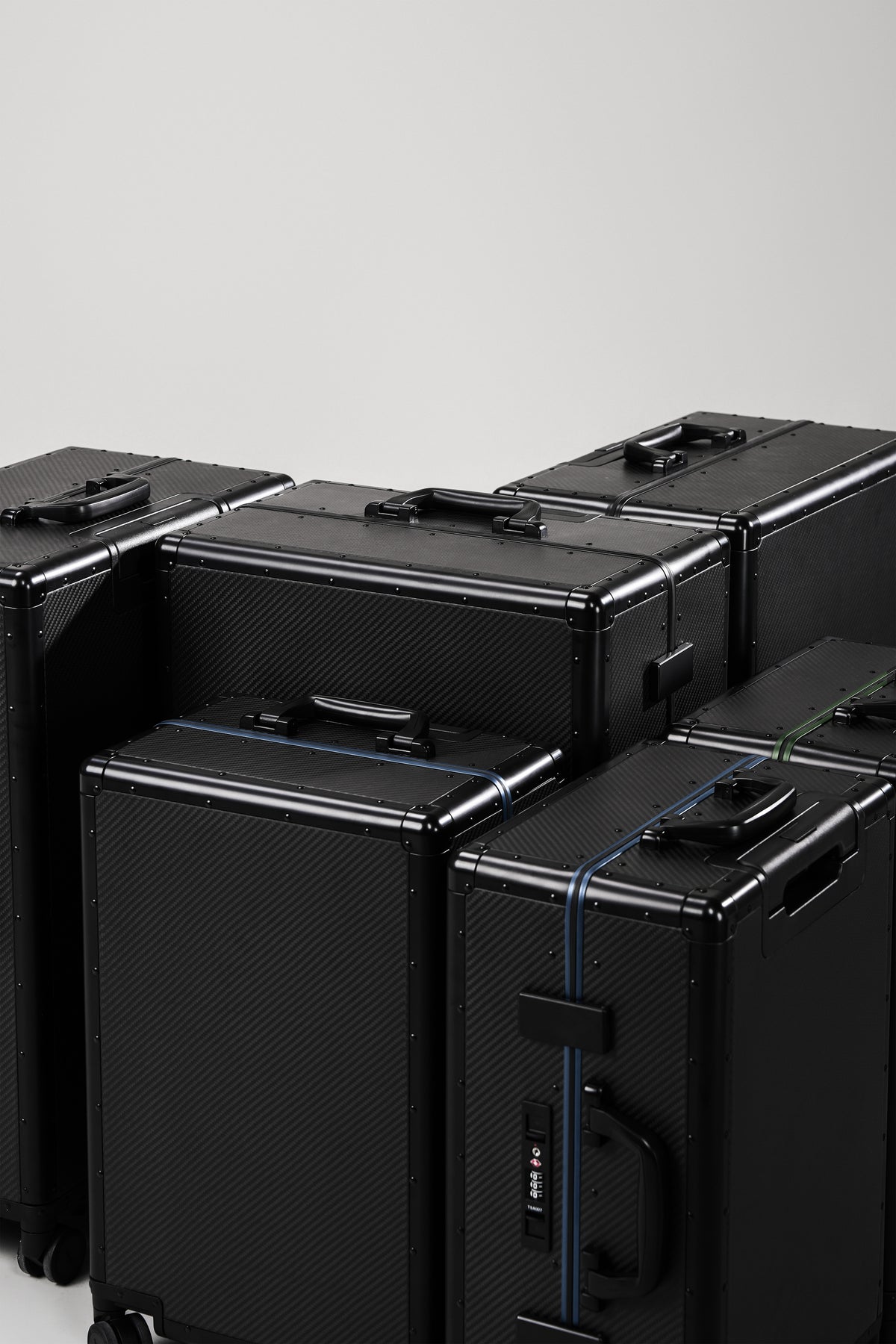


A metal suitcase frame is the rigid perimeter structure running around the case opening. It is not the shell. The shell forms the broad panels, while the frame keeps the two halves aligned and gives the hinges, latches and lock something solid to mount into. Replacing a fabric zipper with that frame changes the closure architecture: the case now shuts on mechanical latches secured by an integrated lock. None of that makes a case theft-proof, weatherproof or indestructible, whatever page one says.
MVST's TREVA metal suitcase is one current example of this construction, and the sections below explain each part before returning to it.
Inside a Zipperless Metal Suitcase, a Quick Anatomy Map
Six components, each with a different job. Nothing in this table carries a protection or security score, because scoring components requires products tested under one shared protocol and no such test exists across this category.
| Component | Primary role | What it can affect | Evidence needed for a named suitcase |
|---|---|---|---|
| Aluminum shell | The broad hard-shell enclosure | Panel stiffness, denting, surface wear, overall case shape | Alloy and temper, thickness, forming method, shell geometry |
| Perimeter frame | The rigid opening interface | Alignment of the two case halves, and mounting for hinges, latches and lock | Frame material, section profile, joints, shell attachment |
| Reinforced corners | Local protection at edge and corner zones | Corner wear, shell-edge protection, local hardware protection | Guard material, thickness, fasteners, impact evidence |
| Hinges and latches | Mechanical opening and closing | Opening path, latch engagement, frame alignment | Hardware material, attachment, cycle or impact evidence |
| Integrated TSA lock | Locks the closure while allowing recognized inspection access | Access control at the latch, and airport inspection compatibility | Lock model or standard, brand wording, reset instructions |
| Seal or frame interface | The contact surface where the closed halves meet | Gap control, and potentially environmental resistance | The exact gasket or seal design, plus any published ingress test |
What Is a Metal Suitcase Frame

Perimeter Frame Versus Shell
The frame surrounds the opening. The shell forms the broad panels. They are not the same part and the words are not interchangeable, even when both happen to be aluminum.
Frame Versus Trolley Handle
The telescoping handle is a separate subsystem with its own tubes, stages and mounts. It is often aluminum too, which is why product copy sometimes blurs the two. A frame problem and a handle problem are different repairs.
What the Frame Can Influence
Three things: whether the two halves line up, whether the hinges, latches and lock meet correctly, and how stiff the case feels around the opening. Alloy families matter here in general terms. The Aluminum Association notes that 6xxx-series alloys are widely used for extruded structural shapes, which is the typical route for a frame profile.
What Still Has to Be Verified
For any named suitcase, including TREVA: the frame alloy and temper, the forming or extrusion method, the section profile, the corner joints and how the shell attaches to it. None of that is published on a typical product page, and none of it should be guessed.
Full Aluminum Versus Aluminum-Frame Hybrid
This is where most buyers get caught, and it is worth being blunt about.
- Full aluminum: metal shell panels plus a rigid framed closure. TREVA, the RIMOWA Original, the TUMI 19 Degree Aluminum and the Zero Halliburton Classic Aluminum 3.0 are all aluminum-bodied cases. See how premium aluminum cases compare on price and specs.
- Aluminum-frame hybrid: a polycarbonate or other non-metal shell paired with an aluminum perimeter frame. The Away Aluminum Edge is a current example, and its name says aluminum while its shell is polycarbonate.
- A case is not full aluminum because its frame, corners or hardware are metal. Read the shell specification, not the product name.
- Compare finished weight, shell behaviour, price, closure design and service model at the model level, because these two builds behave differently under impact.
How the Aluminum Shell and Frame Work Together
Shell Panels Enclose the Case
The broad panels provide the hard-shell surface and take both spread-out and localised loading. On a metal shell, a hard local hit can leave a permanent dent while the case still functions.
The Frame Controls the Opening
The perimeter structure holds the opening geometry so the hinges, latches and lock can meet correctly trip after trip. That is the frame's real job, and it is a more modest claim than the roll-cage language you will find elsewhere.
Joints Are Where Claims Get Tested
The shell-to-frame attachment, the hinge zones and the latch mounts are interfaces. A rigid shell bolted to a poorly executed joint is not a durable suitcase, and joint quality is exactly what a spec sheet never shows.
Loaded and Empty Behave Differently
A packed case, the impact location and where the hardware sits all change how the whole thing responds. That is one reason single-number durability claims mean so little.

Why Reinforced Corners Matter

Corners and edges take a disproportionate share of contact during drops, conveyor handling, loading and storage. A corner guard adds local material at those zones, protects the shell edge and, depending on the design, covers a joint or hardware region.
How much it helps depends on the guard material, its thickness, how it is fastened and which direction the impact comes from. TREVA's product page confirms reinforced corner guards but does not publish the guard material, thickness, fastening method or any quantified impact benefit. So the honest statement is that the component exists and protects a vulnerable zone. Anything beyond that needs a documented test.
How Zipperless Hinges and Latches Close the Case

The Hinge Side
The two halves rotate around one or more hinges rather than separating along a zipper path. Hinge count and position are product-specific.
The Latch Side
Mechanical latches pull the frame halves into their closed position. Latch geometry and engagement depth vary by product, and that is what makes a closure feel solid or vague in the hand.
Capacity Is Fixed
Most framed zipperless cases have no expansion. The case closes when the contents fit inside a fixed shell and frame geometry, or it does not close. For some travelers that discipline is welcome. For others it is the reason to buy a zipper.
Alignment Is the Failure Mode to Watch
A bent frame section or a shifted hardware mount can stop a latch engaging properly even when the shell looks fine. Travel + Leisure's zipperless testing illustrates the point: reviewers threw cases from tables and hit them with baseball bats, and on one hybrid model a latch came slightly undone after a throw, which they noted had been left unlocked. Treat that as an observation about alignment rather than a verdict on any brand.

What TSA-Recognized Locks Do, and Do Not Do

This is the most misread feature in the category. The TSA explains that recognized locks let screening officers open a bag for inspection when a physical check is needed. It has agreements with Travel Sentry and Safe Skies that give officers universal master keys, so certain branded locks may not have to be cut.
Read that carefully. It is inspection access, and the TSA is explicit that locks can still be cut when a bag cannot be opened otherwise, and that it is not liable for damage to locked bags opened for screening.
So an integrated lock secures the latch against ordinary opening, and recessing it into the frame protects the cylinder from sorting machinery. What TSA recognition does not certify is resistance to prying, cutting, drilling, impact, theft or weather. It is not a security rating, and every case in the comparison table below has one.
TREVA's page uses the wording TSA-approved locks. That is a brand-stated specification. In general explanation, TSA-recognized or TSA-compatible is the more accurate phrasing. TSA locks explained covers how these locks open at screening.
Zipperless Frame Versus Zipper Closure
- Frame and latches: a rigid opening perimeter, fixed capacity, discrete mechanical closure points, more hardware and usually more empty weight.
- Fabric zipper: a flexible perimeter, often lighter, sometimes expandable, relying on the coil, the sliders and the tape.
- On security, removing the zipper removes one tampering pathway. The framed case still has hinges, latches, locks and joints, and each of those depends on build quality. Neither closure is impossible to force.
- On weather, some framed cases use a gasket and some do not. Away publishes a water-resistant gasket on the Aluminum Edge. Treat sealing as a model-specific feature with a model-specific test, never as a property of zipperless construction.
Are Metal Suitcases Better
Not universally, and the frame is only part of the answer.
Reasons to choose metal: a rigid feel, a zipperless closure, integrated locks, a distinctive metal surface, and hardware that is serviceable on some designs. Trade-offs: higher empty weight than most plastic and fabric cases, visible dents and scuffs, fixed capacity and premium pricing. MVST Product Care notes that scratches, scuffs and small dents can develop through normal use, which is the honest expectation to set on any metal shell.
Durability is not one property either. It covers the shell, the frame, the wheels, the handles, the locks and whether the thing can be repaired. Metal wins some of those and not others.
How TREVA's Published Construction Fits the System
Here is what the current page states, and nothing more. The TREVA aluminum suitcase specifications list a 5083-O aluminum alloy shell, reinforced corner guards, a zipperless frame, TSA-approved locks, RIVA tri-bearing wheels and a multi-stage aluminum telescoping handle. The carry-on is 21.7 by 14.8 by 8.7 in at 34 L and 9.37 lb, with measurements including the wheels, and the collection starts at $399. Our guide to what 5083-O aluminum is explains the alloy and temper.
What that feature list does not establish: the frame alloy, the extrusion method, the latch geometry, the hinge design, any gasket specification, the corner-guard material or how load travels through the case. Those are separate facts requiring separate evidence, and none of them can be inferred from the bullet points.
Real-World Metal and Zipperless Examples
Five current carry-ons spanning full-aluminum and aluminum-frame hybrid builds. Examples, not rankings, and not a controlled durability comparison, because shell materials, frame designs, lock hardware, sizes, interiors and service models all differ. Verified 13 September 2026.
| Product | Construction and frame context | Exterior and capacity | Weight | Closure and lock | Price |
|---|---|---|---|---|---|
| MVST TREVA Carry-On | 5083-O aluminum alloy shell; reinforced corner guards; zipperless frame | 21.7 × 14.8 × 8.7 in; 34 L; includes wheels | 9.37 lb | Brand-stated TSA-approved locks | $399 starting |
| RIMOWA Original Cabin | Anodized aluminum body; framed hard-shell design | 21.7 × 15.8 × 9.1 in; 35 L; includes wheels and handles | 9.5 lb | TSA-approved locks | $1,550 |
| TUMI 19 Degree Aluminum International Carry-On | Aluminum; frame-system opening; protective bumpers | 22 × 14 × 9 in; 31 L | 11 lb | Two integrated TSA combination locks | $1,295 list, $1,035 sale observed |
| Zero Halliburton Classic Aluminum 3.0 International Carry-On | Classic aluminum body; traditional framed metal construction | 22 × 14 × 9 in; 33 L | 11 lb | TSA lock | $1,245 |
| Away Aluminum Edge Carry-On | Hybrid polycarbonate shell with an aluminum frame; reinforced corners | 21.7 × 14.4 × 9 in; 35 L; includes handles and wheels | 10.1 lb | Dual recessed TSA-approved locks; brand-stated water-resistant gasket | $425 |
The Away row is the useful one. It is the lightest-sounding name in the group and the only non-metal shell, at 10.1 lb, which is heavier than two of the full-aluminum cases. Product names are not construction specifications.
What to Avoid When Buying a Metal Suitcase

- The word aluminum in a product name when only the frame, the trim or the colour is metal.
- Aerospace-grade, aircraft-grade, indestructible, vault-like, tamper-proof or waterproof with no named material, specification or test behind it. The Federal Trade Commission's position is that objective product claims need a reasonable basis before they are published, and that applies to every brand in this category.
- No published empty weight, exterior dimensions or capacity.
- No explanation of the lock type, the latch system, the warranty, the repair route or replacement parts. MVST's Limited Lifetime Warranty is the formal document for its own lines, and the exclusions matter more than the headline.
- Comparing a full-aluminum case against a hybrid as though they share the same shell construction.
Explore MVST TREVA Aluminum Luggage
TREVA is MVST's full-aluminum line, with a brand-stated 5083-O shell, reinforced corner guards, a zipperless frame and TSA-approved locks, in carry-on, medium and large sizes from $399. Explore MVST TREVA aluminum luggage for the current published dimensions, capacity and weight by size.
Conclusion
A zipperless metal suitcase works through the interaction of shell, frame, corners, hinges, latches and lock. The frame earns its importance by keeping the opening and the closure hardware aligned, not by absorbing every impact. No single component proves superior durability or security, so read the shell and frame materials separately, check the published weight and dimensions, and look at the repair path before you judge a case by its closure.
FAQs
Are metal suitcases better?
Not always. Metal luggage is better when you value a rigid, zipperless case and accept its trade-offs:
- Best for: fixed-capacity packing, a structured feel and visible metal construction.
- Less suitable for: strict weight limits, expansion needs or travelers who dislike dents and scuffs.
What are those metal suitcases called?
They are usually called aluminum suitcases, metal suitcases or zipperless framed luggage. Check the shell specification: "aluminum" may describe only the frame or trim on a polycarbonate-shell hybrid.
What is a metal suitcase frame?
A metal suitcase frame is the rigid perimeter around the opening. It aligns the two halves and carries the hinges, latches and lock; it is separate from both the shell panels and the telescoping handle.
Are aluminum suitcases worth it?
Yes, for the right buyer. An aluminum suitcase may be worth the premium if you want rigid, zipperless construction and can accept higher empty weight, fixed capacity and cosmetic wear. Before buying, check the dimensions, empty weight, warranty and repair support.
What should you avoid when buying metal luggage?
Avoid products that leave basic construction or ownership details unclear:
- No explicit shell material or a product name that uses "aluminum" only for the frame or trim.
- Unsupported claims such as "aerospace-grade," "indestructible" or "tamper-proof."
- Missing exterior dimensions, empty weight or capacity.
- Vague lock specifications or reset instructions.
- No clear warranty, repair route or replacement-part availability.
Which is better, aluminum or titanium luggage?
Aluminum is the more practical benchmark because verified full-titanium suitcases are rare. Compare the actual material, not the product name:
- Aluminum: widely used for rigid metal luggage, with more published product specifications and service options.
- "Titanium" listings: often describe a color or finish rather than a full titanium shell.
Do TSA locks make a suitcase more secure?
Yes, but only against casual opening. A TSA-recognized lock lets authorized screening personnel open the case without the owner's combination; it is not a rating for resistance to theft, cutting or prying.
Is zipperless luggage better than zippered luggage?
Neither is universally better:
- Zipperless luggage uses rigid latches and has fixed capacity, but it depends on precise frame and hardware alignment.
- Zippered luggage is often lighter, more forgiving when packed tightly and sometimes expandable.
Choose based on how you pack and the quality of the complete case, not the closure type alone.
Do airlines prefer hard or soft luggage?
No. Airlines regulate dimensions, weight, item count and safe stowage - not hard versus soft construction. Measure the packed bag, including wheels and handles, then check the operating carrier's current limits.
How long should a metal suitcase last?
There is no reliable universal lifespan. Service life depends more on the wheels, handles, latches, frame alignment, impact history and repair support than on the metal shell alone. Prioritize replaceable parts and warranty service over a promised number of years.
Sources
出典・参考資料
- [1]Transportation Security Administration, Travel Tips, baggage and recognized locks, US Department of Homeland Security. Recognized locks allow screening officers to open a bag for inspection. Locks can still be cut where necessary, and TSA is not liable for damage to locked bags opened for screening. Accessed 13 September 2026.
- [2]Transportation Security Administration, Security Screening, baggage inspection, US Department of Homeland Security. TSA holds agreements with Travel Sentry and Safe Skies providing universal master keys, so certain branded locks may not have to be cut. Inspection access only, not a security rating. Accessed 13 September 2026.
- [3]The Aluminum Association, Standards, wrought alloy designation and series applications, The Aluminum Association. Alloy family context, including the 6xxx series commonly used for extruded structural shapes. It does not establish the frame composition of any suitcase. Accessed 13 September 2026.
- [4]Federal Aviation Administration, Carry-On Baggage Tips, Office of Aviation Safety, US Department of Transportation. Carriers set their own carry-on rules and can be stricter than general guidance. It expresses no hard-versus-soft material preference. Accessed 13 September 2026.
- [5]Federal Trade Commission, Policy Statement Regarding Advertising Substantiation, Federal Trade Commission. Objective product claims require a reasonable basis before they are disseminated. Cited as the standard a construction, security or durability claim should meet. Accessed 13 September 2026.